
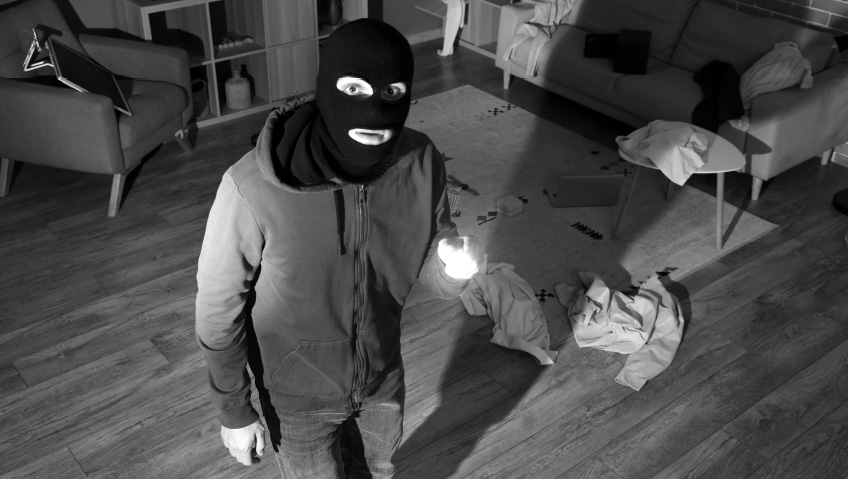
Fear of burglars and home invasions is driving interest in residential security systems, ranging from high-tech door cameras and alarms to the car-blocking posts known as bollards.
Ironically, this new spike in home security investment is coinciding with an era where property crime is on the decline. “Break and enters were less common [in Canada and the United States] than they were 25 years earlier,” states Statistics Canada’s Trends in Police-Reported Crime in Canada and the United States, from October 8, 2025.
In 1998, there were 4,158 incidents of property crime in Canada per 100,000 people and 4,052 incidents per 100,000 people in the United States. By 2023, that had dropped to 1,995 incidents per 100,000 people in Canada and 1,906 incidents per 100,000 people in the U.S., states Statistics Canada. Such data is cold comfort, however, in an era of high-profile media accounts sharing brazen car thefts, residential break-ins, and retail robberies caught on video. And, as the title of the Statistics Canada analysis suggests, not all crime involving private homes gets reported.
Fortunately, there is no shortage of home security measures available to property owners, some of which have surprisingly long histories.
Centuries ago, domestic and wild animals alike were commonly used to guard home and hearth. Dogs, pigs, and geese, a notoriously noisy species, were all employed in this fashion. Today, outside of farm country at least, only dogs retain an important role in protecting homes.
The 1850s marked the introduction of electromagnetic burglar alarms. Augustus Russell Pope of New England is credited with developing a solution involving metal contacts on windows and doors connected to copper wires running on an electromagnetic circuit. If the circuit was disrupted by someone trying to open a window or door, a bell started clanging.
Pope sold the rights to his alarm system, and eventually a commercialized version became available. By the turn of the 20th century, a handful of homes, businesses, and buildings were fitted with burglar alarms. Sometimes, these alarms were connected to police stations to ensure a speedy response from law enforcement.
Early burglar alarms only offered an audio component. They might scare off a burglar but did not provide any images that would be helpful in tracking down criminals. This changed with the arrival of Closed-Circuit Television in the 1940s. In a CCTV setup, footage from a surveillance camera is displayed on a monitor. It was a major step forward for security, but not ideal. Early CCTV systems did not record the footage, so unless someone sat and actively watched the monitor at all hours, they weren’t much use as a security system.
In the 1950s, the advent of videotape recorders meant that CCTV camera footage could be saved and stored, initially on reel-to-reel tapes and later on video tapes. By the 1970s, CCTV systems with videotape recorders had become ubiquitous in banks, businesses, and other buildings. In April 1974, a CCTV camera in a San Francisco bank famously recorded black and white footage of kidnap victim Patty Hearst brandishing a rifle during a holdup. Whether through coercion or conviction, Hearst had joined the self-styled revolutionaries who abducted her and participated in their crimes.
Still, CCTV systems were pricey and out of reach for homeowners except for the very wealthy. In the mid-1960s, an African American nurse named Marie Van Brittan Brown came up with a way to modify and simplify cumbersome CCTV technology for home use. Brown and her husband, Albert, an electronics technician, lived in the borough of Queens in New York City. They both worked erratic shifts and worried about rising crime rates. Together with her husband, Brown developed a unique security solution for the front door of a house.
The solution involved “four peepholes” through which “a motorized video camera on the inside could view visitors of different heights as the occupant toggled the camera up and down. The camera was connected to a television monitor inside. A microphone on the outside of the door and a speaker allowed an occupant to interrogate a visitor, while an alarm could alert police via radio,” states A Brief History of the Invention of the Home Security Alarm in the March 2021 edition of Smithsonian magazine.
The Browns filed a patent for their system in 1966, which gained approval in 1969. While hailed as the pioneers of the home video security system, Brown never reaped much financial reward for her invention, which was expensive to install. She died before technological advancements made home video security systems a realistic option for homeowners.
These advances included the advent of digital recording. Surveillance footage could now be saved on hard drives with massive memory, eliminating the need for bulky video tapes with limited recording time. Cameras became smaller, which led to the emergence of surveillance cameras specifically designed for use at home. “Nanny cams,” discreet digital cameras that could monitor babies, kids, and assets inside homes, were introduced in the early 1990s.
Another technological leap occurred in 2014, when entrepreneur Jamie Siminoff introduced his doorbell camera system. Originally called DoorBot, this solution blended a doorbell with a surveillance camera element capable of capturing footage of visitors on the doorstep. The product was renamed the Ring Video Doorbell, and Siminoff sold his company to Amazon.
The Ring Video Doorbell was inexpensive and available in retail channels, making it a popular choice for homeowners. And today, there are many competing options for doorbell cameras available for security-conscious property owners.
From the original model, new features kept being added to the Ring Video Doorbell. A Night Vision solution enhanced surveillance footage shot under dark conditions. A Live View feature enabled users to communicate with anyone on their doorstep via a smart phone or other device. Motion detection features were tweaked, improving the system’s ability to pick up unexpected presences and send alerts to homeowners.
Dashboard or car cameras have become another popular security measure. Such cameras are typically installed inside a vehicle, facing forward to capture footage through the windshield. While the concept is not new—police departments have used dashboard cameras for decades—car cameras have enjoyed a surge in popularity. This is partly due to seemingly endless online posts from users depicting amusing or alarming incidents they filmed while driving.
Entertainment value aside, dashboard or car cameras provide an additional and accessible layer of security for the public. Footage recorded by car cameras is commonly used to settle insurance claims in the case of accidents or mishaps.
Beyond cameras and alarms, bollards are emerging as a reliable means of preventing car theft. A bollard is simply a post, about three or four feet tall, made from cast iron, stainless steel, concrete, or other materials. Bollards have been a common feature at wharfs for centuries, used by ship crews to tie up mooring lines. At some point, bollards became incorporated into traffic infrastructure, blocking or guiding vehicles, defining and protecting walkway perimeters, and more recently, delineating bike lanes.
Permanently secured bollards have started to appear in front of retail outlets selling high-end goods as a precaution against ram raiding. This term refers to a smash and grab attack in which criminals slam a vehicle into a retail outlet that features a secured, locked door. The idea is to shatter the storefront glass, enabling easy entry for robbers. Bollards can stop a vehicle before any glass is hit.
In a similar fashion, some homeowners have taken to installing bollards on their driveways to secure their cars. Since permanent posts would not be practical on a driveway, homeowners rely on retractable bollards to protect their parked vehicles.
Ranging in price from a few hundred to several thousand dollars, bollards have become a common sight in wealthy neighbourhoods of Toronto, where car theft is rampant. When a homeowner wants to enter their driveway, the bollards are lowered automatically via a sensor or remote control, or manually with a key. Once the driver parks, the bollards are raised, making it impossible for car thieves to exit with the vehicle. Since they are featured on driveways, homeowners in Toronto at least do not require permits or special bureaucratic permission to install bollards.
As residential security continues to evolve, artificial intelligence is likely to play a growing role, helping systems analyze potential threats, identify unusual activity, and alert homeowners with greater precision. These tools may increasingly draw on broader data sets, from neighborhood crime patterns to real-time video analysis, further extending the reach of modern home protection.
From guard animals and early alarm bells to digital cameras, doorbell systems, and driveway bollards, the history of home security reflects a constant effort to adapt technology to everyday fears. While crime statistics may ebb and flow, the desire to protect one’s home remains unchanged, driving innovation that blends peace of mind with practical defense.