Known for its natural splendor along the shores of Lakes Muskegon and Michigan, the city of Muskegon is arguably one of West Michigan’s most precious and dynamic economic hubs.
Muskegon’s economy is underpinned by entrepreneurship and a culture of cutting red tape. As a result, investors looking to settle here are met with a warm welcome and generous support from the local economic development department. The city and its economic development department offer progressive zoning reforms and tax incentives, reasonable turnaround times for plan reviews and building inspections, and brownfield development abatements.
“The city of Muskegon is developing the most investment-friendly environment and public service organization in West Michigan,” explains Jake Eckholm, Director of Development Services. Working closely with the Muskegon Lakeshore Chamber of Commerce and Community Foundation for Muskegon County and fully supporting its commitment to developing the local workforce means fostering close relationships with all stakeholders across the county.
Impressive growth is driving expansion in the city’s manufacturing, healthcare, and senior living industries, as well as the commercial sector, but the real economic action is in housing. Here, on average, homes are still about a third less expensive than in some neighboring communities. As part of Muskegon’s commitment to help solve West Michigan’s housing dilemma, enabling the construction of new housing in every price range is a large part of the department’s mandate.
To achieve this and help close a 2,924-unit housing gap, including the demand for 1,611 rental units, the city has adapted its zoning codes to accommodate the construction of duplex and triplex units in its residential areas. A plan for 1,500 new units is being rolled out over five years to fulfill the need. More single- and multi-family homes and affordable housing are also in the pipeline.
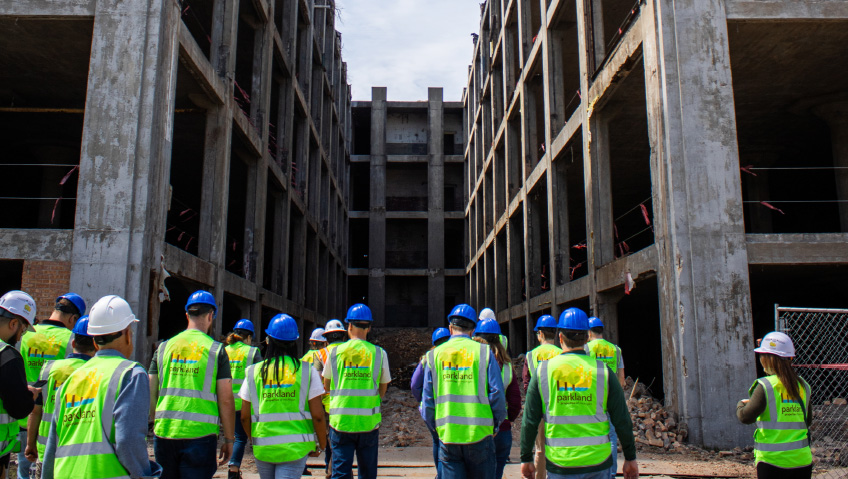
Together with comparatively smaller developments on the lakeshore, the state’s largest adaptive reuse project, The Shaw Muskegon—formerly home to the largest global furniture fabricator—is now being redeveloped following decades of neglect. The $230 million development will introduce 500 of the city’s planned new units. The project is being built on one of fewer than 10 transformational brownfield plan approvals by Michigan state officials.
Eckholm is proud of the high level of assistance the economic development department provides to developers in navigating their legislative and fiscal responsibilities. “The city of Muskegon offers the whole suite of statutory tax incentives that the state of Michigan provides, but in addition to that, we try to be very forward-thinking on what can help a project succeed,” he says. “I think we are one of the few communities in West Michigan that really make that effort and work with the developer,” as opposed to expecting them to come to the city with their needs.
Due to its vision and commitment to expansion, the department was nominated for the University of Utah’s David Eccles School of Business Ivory Prize for housing affordability this year, a National top three finalist alongside Los Angeles County and the State of Florida while outperforming cities like Boston, Philadelphia, and Baltimore. The award is in recognition of the city’s development of a brownfield project of approximately 435 city-owned, vacant, residential lots that will soon become housing developed by the city and sold just under value, the shortfalls of which will be covered by proceeds from other properties sold to developers.
Here, developers are permitted to build whatever types of housing they prefer, putting home ownership within reach for a much larger part of the population. “We think we build the most affordable, stick-built, site-built housing in the country,” Eckholm says. As part of these efforts, the department is in the process of completing four low-income housing tax credit projects that will provide 294 affordable workforce units and senior living units.
Part of Muskegon’s invigoration strategy has been to ensure that, while local construction leaders benefit from the expansion, other firms from areas like Southeast Michigan and the Detroit Metro area also have a stake in the city’s growth. “We at the city, when it’s a bid on public work getting done, have a local preference policy,” Eckholm explains. “The job to redevelop this community is large enough for everybody, so we’ve really been focused on bringing more folks into the market at all phases of development.”
This balanced approach has benefited local contractors and allowed operations from across the region to set up satellite operations, promoting equity, investment, diversity, and above all, powerful economic growth.
For prospective investors looking to settle in Muskegon, some land is still available. The city currently has a 30-acre industrial park lot, with private and public utilities. Two comparable lots were recently sold, one of which was purchased by one of Michigan’s largest private research laboratories, Northern Biomedical Research. The second parcel went to Forming Technologies, which recently expanded into a new 215,000-square-foot facility.
Muskegon’s economic development strategy is not all about growth, however. In addition, the team works hard to protect and support the needs of residents who call this beautiful place home. The local people, and especially the youth, who give the place its unique charm and character are very much at the epicenter of the city’s vision. “We want to serve folks that have been here historically, who have stuck with the community,” Eckholm says. Because of a lower education attainment rate, resulting in a lower average income, this work is crucial to improving the prospects of young adults in the area, and this is where welcoming more people becomes important.
By establishing a more robust tax base, more public services become possible. This leads to more meaningful economic collaborations with educational and trade institutions, while rethinking the incarceration system. In this way, the city plans to strengthen and develop its already strong labor force. By attracting companies that pay well, the overall income problem is further addressed on multiple levels.
“We have to leverage this development to benefit folks that are already here,” Eckholm emphasizes, highlighting that, as incomes improve, every addition to the housing market affects another demographic’s housing situation. In light of its most recent census showing a 12,000-person drop since 1950, promoting the city to new arrivals will help achieve the fiscal goals set to improve the quality of life for all.
Muskegon’s existing industries remain resilient, particularly manufacturing, healthcare, and senior living, its biggest employers. Here, too, construction has not lagged; while one former hospital made way for 144 new apartments this year, another was built just six years ago for around $280 million. More recently, a new $90 million Trilogy Health senior living facility, offering a comprehensive service portfolio including memory care, assisted living, and independent living, was also established.
With its focus on the future, Muskegon’s education sector also offers myriad choices. Muskegon Public Schools is one of the first in the country to adopt the Ford Innovation Academy curriculum, providing a wide selection of academic, athletic, and arts activities.
Muskegon’s arts scene is indeed alive and well, and diverse restaurants cater to locals with roots from around the world. Some of the city’s most outstanding amenities include the distinctive and elegant Frauenthal Center, with its old-world romance—a theater and venue for the arts featuring performances by groups visiting from as far away as Ukraine, with a recent visit from the Grand Kiev ballet company. Moreover, the West Michigan Symphony Orchestra regularly performs for residents and visitors who appreciate the delights of classical music.
The Muskegon Museum of Art has the second-largest permanent collection in the state, following Detroit. In addition, its public arts scene is supported by the largesse of a late benefactor and founder of the city’s only company that was ever listed on the S&P 500. Thanks to his foresight in securing funding, the Muskegon City Public Art Initiative was founded in 2018.
A number of sports teams represent the city, which also boasts a junior hockey team, the Muskegon Lumberjacks, and an active, city-owned sports arena welcoming visitors in addition to the indoor arena football team, the IronMen. The Muskegon Luge Adventure Sports Park, meanwhile, is home to winter sports activities. Exceptionally well-equipped with ice-skating, cross-country trails, and much more, “it’s one of the only luge tracks in North America,” Eckholm says.
The natural environment is also on the city’s priorities list. While its mercantile export and import capabilities are among the most solid aspects of its manufacturing economy, the Muskegon Lake Watershed Partnership, formed by a group of concerned citizens, is in the process of remediating the health of the lake. Following an investment of around $90 million, the situation has already improved for this precious water body. “This year, we were removed from the Areas of Concern List for waterbodies in North America,” Eckholm shares. The lakeshore also has Michigan’s largest operating commercial port, managed by the U.S. Army Corps of Engineers.
The possibility of a new park has spurred much public discourse, but caring for nature and debating public spaces are not the only things locals are passionate about. They also enjoy gathering at their local farmers market with 144 seasonal and 24 year-round stands—the second-largest in the state. The market sees around 15,000 visitors pass through on Saturdays in season. Locals also support small businesses, like those in Western Market’s brilliant business incubator initiative, where a delightful row of 17 fledgling enterprises trade unique and exciting wares before launching into bigger premises once they are off the ground.
Having built its wealth first on French trading posts and later on logging, which saw the city supply most of the wood used in Chicago’s reconstruction following its historic fire in 1871, the Muskegon of today is every bit as proactive and future-driven as its founding fathers once were. Care for the people who call Muskegon home is at the center of everything the city does, and the enormously dedicated team upholds and enables progress, taking this city to ever greater heights.