“People think that all rental housing providers do is simply collect rent, but we’re actually continually navigating a really complex system,” says Amanda R. Knight, founder of Knight Growth Strategies. Knight is a passionate advocate for housing affordability in Nova Scotia. “I don’t just look at providing a building or a unit or a home—I’m actually managing a community.”
Currently, that means managing her units and the people living there, as well as dealing with neighbours and others to handle any number of issues and concerns. “Those [issues] include an increase in mental health issues, income instability, and social support needs, all going up,” she shares.
In addition to those particular challenges, Knight is also drawn to older properties—the “fixer uppers”—that generally require much more time and care. “It’s my love,” she says. “People call me crazy because of it, but I do love the older properties even with the ongoing maintenance and capital investment. I’ve always got windows or doors, roofs, and furnaces to update, and then we’ve got the ever-increasing cost of local regulation to deal with.”
Homeowners understand the never-ending upkeep that comes with maintaining their own properties, and for Knight, that cost is multiplied exponentially. “With a duplex or a four-unit building, you’re multiplying all of those costs and time constraints times the number of units, plus dealing with people living there who may not have an understanding of things. So, yes, it’s not as simple as just collecting rent.”
While there is always some backlash against landlords, particularly in the media, Knight has a deep understanding of—and empathy for—those who are looking for housing who simply can’t afford to buy on their own, particularly now with a nationwide housing crisis.
“We all know the people who are living in our properties, and we do look at them as family and friends,” Knight says. “We’re involved in their lives. I’ve got people with me whose kids were two when they moved in, and now they’re five and six and going to school, navigating school and daycare and all those other things. We very much are aware of what’s going on in our tenants’ lives.”
Combatting that image of the heartless landlord can be difficult, which is why Knight is committed to her community first, not only assisting those who need attainable housing, but ensuring she employs local tradespeople to help with her properties’ ongoing upkeep. To that end, connections within the community are vital.
“I’ve got partnerships with my tradespeople,” Knight says. “I’ve got my go-to plumbers and electricians I can call at seven o’clock on a Sunday morning, and they’ll answer because they know there’s an issue.”
Along with her contractors and service companies, Knight also fosters strong partnerships at the municipal level with the town and other local support providers, and works with several community organizations that provide additional support to the tenants who live in her properties. “Partnerships are massive,” she stresses. “We deal with so many different people. I think with partnerships, it does allow us to leverage our expertise.”
And while her love of old homes—particularly their character and quirkiness—persists unabated, they do give her a “headache with repairs. I know what I’m good at, though,” she says. “I’m good at finding underutilized properties, or properties that are really run down, and I restore them.”
Even when Knight’s trusted tradespeople advise her to move away from the old to embrace the new, she perseveres. “I have the skills to do it. I’ve got the contacts to do it. My skills are transferable, but I know what I like,” she says. “I know what I can get back onto the market in a livable state, which means getting more housing created quickly. Existing homes are faster to turn around; even with renovations, they’re less expensive and they’re within my wheelhouse. That’s what I focus on, and that’s where I focus with my partnerships, too.”
While Knight understands the appeal and potential beauty of new homes and why other landlords may be more drawn to them as investments, her passion lies elsewhere. “The new stuff is absolutely beautiful, but there’s no life to it,” she says. “If you need a roof over your head, you need a roof over your head. The old homes are quirky and quicker to turn around because you’ve already got access to water and sewer, and usually they’re in town on either bus routes or walkable for a lot of people.”
Indeed, transportation challenges are ones she continually takes into consideration for her renters. “It may be a bit more challenging because I’m also rural, in a smaller community,” Knight says. “For public transit, we’ve got community transit but not traditional transit as you’d find in the bigger centres. Walkability is absolutely a big concern for people.”
It’s about being strategic, she stresses. “My partnerships are strategic, my locations are strategic. You have to take all of that into the equation.”
With this in mind, Knight’s renters are generally located close to grocery stores, medical centres, downtown, or their place of work, and if something happens with a vehicle and they don’t have the money to fix it, they aren’t stuck. “You can still make it to your job and to get the necessities, which in turn means you’re going to be happier where you live,” she says. “You’re going to respect the property, you’re going to maintain it, and you’re going to want to pay your rent and bills on time. That’s how we all work as a partnership.”
Knight also stresses that while she loves bigger cities and all they have to offer, providing rentals in more rural areas offers unique benefits that may be overlooked by others. “Being rural, you’re so interconnected. You go to the grocery store or walk downtown, and somebody you know will see you. If we had more people in every rural community who had a similar mindset or skill set to take all of these things into place, we could put a big dent in the housing challenges we’re facing right now just by having more community involvement and discussion around it.”
With a severe shortage of affordable housing plaguing almost every city across North America, Knight’s vision is a welcome one. “We’ve got so many people trying to bring employees into work on every level: blue collar, white collar, all the way up. We’ve got some of the smartest people with the greatest connections, and yet we can’t tackle this issue.”
Knight, who personally works closely with several local organizations like Healthy Pictou County, which relocates doctors and other healthcare professionals, finds the process frustrating. “If we can’t find housing for doctors and people in healthcare, our healthcare will continue to fail. I don’t understand why more people aren’t working with other employers and building that relationship.”
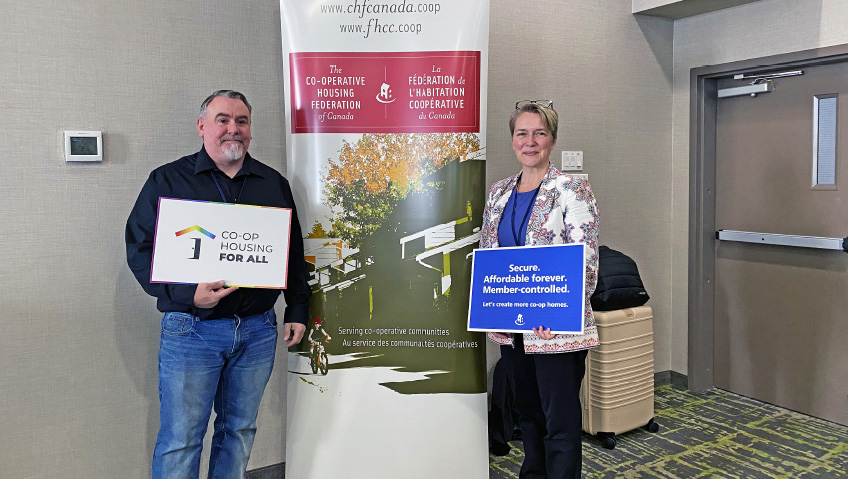
Other important work for Knight includes the Community Housing Transformation Centre, or the Centre, which she joined in November 2022 as a volunteer for a selection committee. Transforming Canada’s community housing sector by catalyzing partnerships, new ideas, and resources, the Centre’s ambitions are for the sector to play a leadership role within Canadian society and to unite the sector around a 20 percent housing market share by leveraging its strengths.
“I specifically joined the Centre because I didn’t have the best impression or understanding of what not-for-profit housing was,” she says. “I had a vision or a stigma of it in my mind, and I thought, here’s an opportunity; it’s a six-month term to volunteer, and I can see what this is actually about. I was super impressed.”
She reviewed several projects through that six-month term, and then was asked to extend her term for a total of 18 months. What she truly liked about the Centre is that they took the recommendations and advice that she, as well as some of the other volunteers, offered, and actually incorporated them into their application process.
“They listened, and they took action,” she says. After her 18 months of volunteering, Knight then applied for the Program Manager position and was hired, specifically brought in to develop and implement the Community Housing Capital Fund. “This tied in nicely, because the Capital Fund provides grants for acquisition and preservation of existing affordable housing, which aligns with some of the things I do in my other life.”
Knight has also had the opportunity to tour “amazing” acquisitions, buildings that were purchased by non-profits and community housing organizations to preserve affordable rents and prevent tenant eviction. Conversions and demolitions are two significant factors contributing to the sharp decline in affordable rental housing units; the Capital Fund has helped protect existing, occupied, purpose-built rental properties.
As rewarding as her business is, there are always challenges, including the rising cost of materials along with mental health and addiction issues, which can create liability concerns for tradespeople entering units.
“If I call one of my trades to go in and fix a leaky faucet in one of my units, I now have to send two people in because they won’t go in by themselves anymore,” she says. “It seems small in the overall scheme of things, but when you’re paying two people to fix something that only takes one person, it’s very costly. Or if I have to take time off from work to meet somebody, I’m also losing my own personal income. It’s sometimes those little things that we forget.”
While Knight does approach housing as a community good and not just a business, it is, essentially, both of those things. “I do make a profit, and I won’t apologize for making a profit, because it’s what allows me to reinvest in my buildings,” she says. “I barely compensate myself for my time as well as my energy and expertise. Everyone’s time is valuable.”
In the meantime, she will continue to do what she does best: devoting herself to turning under utilized housing into treasure. “I’ve purchased a couple of other properties that have been unbelievable, the state that I’ve purchased them in, but I’ve got great people living in one of them, and I’ll have people moving into the next one this year,” she says.
Knight also has some big personal news coming up in the next few months that is sure to further solidify her role in the local affordable housing market. “If you ask me, what do I do in my spare time? I’m probably talking about housing or something to do with housing in some capacity,” she says. “I love it. I don’t consider it a job. I’ve met incredible people, but I think collaboration has been key.”