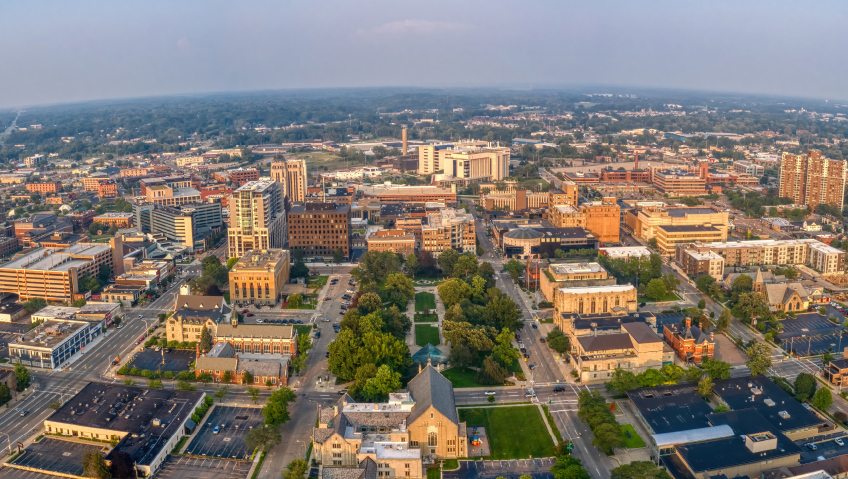

The City of Warren, the third largest in Michigan and Detroit’s largest suburb, boasts not only a diversified population and tax base—with major businesses including General Motors, Chrysler, Macomb Community College, and the rapidly expanding U.S. Army Tank-automotive and Armaments Command (TACOM), the hub of the area’s defense corridor—but also a unique historical background. As it happens, no less than half of all the tanks the United States produced during World War II were assembled at the Detroit Arsenal tank assembly complex located in Warren.
The auto industry has long been important to Warren, gaining traction in 1936 when Dodge built its truck plant at Eight Mile Road and Mound Road.
“From about the end of World War II through the Korean War, GIs would come home and find jobs in the auto industry in the Detroit area,” says Tom Bommarito, Director of the Department of Community, Economic & Downtown Development. “Since there were some new plants and opportunities in the south end of Warren, it grew really quickly at that time.”
“The GI Bill really gave a big push into that area as well,” adds Hunter Manikas, Economic Development Technician. “People could get loans that were guaranteed by the federal government, so a lot of people coming back were building houses there, old-style kinds of developments that were close to their neighbors, and it’s still reflected today in the makeup of South Warren.”
He adds that it’s interesting to see the different development choices through the years. In the 1950s, there were many tight-knit little communities with single-family, smaller homes, and then as development changed over the years—from the 1970s onwards—there were much bigger lots with bigger houses, set further apart.
“You can see it almost like rings on a tree here in Warren,” says Manikas. “There are those early developments, the inside rings, and the outer rings are the later peaks of development. It reflects an interesting artifact of the times for each portion of the city.”
The demands of World War II, followed by the residents returning from war, very much contributed to the area’s growth, while constructing the tanks locally and having ground command for all the vehicles in the army drove much of the manufacturing. Says Manikas, “It’s very much a part of the identity and culture here in the city.”
In keeping with this rich history, the Arsenal Alliance, a Defense Corridor initiative in partnership with Sterling Heights, is a cooperative project to strengthen the defense industry by creating a shared economic development team to deliver contractual services. To safeguard and expand the area’s developing defense assets and enable the two communities to spearhead the next phase of national defense innovation, this team is committed to developing the defense and aerospace sectors in this corridor, collaborating with state, county, and local stakeholders for long-term sustainability and growth.
“[The area’s] defense corridor is considered the second or third most robust defense corridor in the world,” says Bommarito. “That huge activity is a big contributor to both of our economies. Now, with the Selfridge Air Force Base getting some new F-15 fighter jets, even more defense contractors will come looking for a footprint here. This initiative is a good way to partner together and help grow and attract more.”
This historic economic development partnership confirms the region’s position as a national leader in defense manufacturing and innovation, and by contributing just $500,000 a year, the communities will bring in millions of dollars to support strategic economic development objectives that will sustain investment in this critical sector.
“Attracting some aerospace or drone companies to operate here would be big, and we’re making sure that together we can produce the best environment for these companies,” says Manikas. “It’s all about aligning goals with Sterling Heights to ensure everyone can provide the best space for companies like that.”
Warren also recently received a vital $1.8 million grant from the Michigan Economic Development Corporation (MEDC) to help revitalize southern parts of the city. “We have a new corridor plan that will see more infrastructure upgrades, a lot of façade improvements, and some art installations,” Bommarito shares. “The goal is to convince private investors to start taking either empty buildings or empty land and build new buildings.”
The MEDC’s RAP Program, a revitalization and placemaking grant, provides access to gap financing for place-based infrastructure development, real estate rehabilitation and development, and public space improvements. Eligible applicants are individuals or entities working to rehabilitate vacant, underutilized, blighted, or historic structures and to develop permanent place-based infrastructure associated with traditional downtowns, social zones, outdoor dining, and public spaces.
“We’ve been engaged in some of their programs, updating our economic development objectives in line with theirs,” adds Manikas. “They see a lot of potential in the southern portion of our city, so we’re being awarded this $1.8 million for revitalization and placemaking. Something really exciting is happening down there.”
Additionally, city officials are collaborating on a new concept that includes planters and vegetation along the Van Dyke bike lanes with the Michigan Department of Transportation, the Southeastern Michigan Council of Governments, and area engineers and planners. By clearly delineating the auto and pedestrian lanes, these elements improve accessibility and increase bikers’ comfort and safety.
The streetscape design is aimed at slowing down traffic, protecting bike lanes, building new developments up to the curb to make them more pedestrian-friendly, and incorporating parking lots so developers don’t have to put parking in front of their building. “It’s mostly aimed at pedestrian-friendly initiatives,” says Manikas. “It’s about going back to the roots of our history, tapping into what it used to be and using that as a strength rather than fighting against it.”
To this end, the former Warren Transmission, a General Motors automotive factory, is another location in the city’s south end that is promoting economic growth. NorthPoint Development cleaned up and redeveloped the 1.5 million-square-foot site, now known as the Mound Road Industrial Park. Home Depot constructed a brand-new, state-of-the-art, 550,000-square-foot distribution center on the expansive site, and another 300,000-square-foot building is occupied by three distribution companies. Space remains for about 700,000 more square feet of occupancy.
The Class A park will span 123 acres and have four buildings; more than 800 construction and operational jobs are expected to be created in the city as a result of the investment. With on-site rail and its proximity to I-696, I-75, M-53, and M-102, the park enjoys excellent connectivity. According to Bommarito, the industrial park is being considered for designation as an MI Site, a program run by the MEDC that promotes industrial sites that are ready for development to investors and companies looking to move or grow in the state.
Warren is also in the process of working with urban planners to put together a use site plan involving 18 acres of vacant land around City Hall, with plans for a hotel, retail, housing, and a new courthouse as well as a potential seniors’ center.
“All of that is focused right around our town center, and our goal is to create a small, walkable town center area,” says Bommarito. “We’re in the planning stages.”
It is clear that no matter what project is executed, these teams do so with exceptional care and attention. “It’s not a one-size-fits-all approach for the work that we do,” stresses Manikas. “We really have to tailor our objectives, initiatives, and goals to the area, because each section of the city has very different needs than the last one we were working on.”
This means modifying plans to suit the specific needs of each neighborhood and accentuating local strengths. “It can be difficult to bounce back and forth, to make specific policies for specific areas and not be spot zoning, but we really have to do things that are specific for neighborhoods to actually make an impact and build to the needs of that area,” he adds. “I think that’s one of the biggest challenges, but also one of the more exciting aspects of this job.”
The other challenge is simply working within the processes of government, adds Bommarito. “It takes a long time. Sometimes you get pricing, you get prepared for a project, and by the time all the paperwork is signed, the meetings done, and the boxes checked, the price has gone up 30 percent and you have to start over with funding,” he shares. “Some of those things are a bit of a challenge, but that’s what we do.”
And he does it well, says Manikas, adding that Bommarito was the Michigan Economic Developers Association’s Medalist of the Year in 2025 for his outstanding contributions to economic development in the state. “That’s something that we’re all really proud of.”
Understandably, both gentlemen are also extremely proud of every project they undertake for the benefit of Warren and its residents. “Most of the projects we’re talking about, all the initiatives that we have, those really are our accomplishments,” says Manikas. “Those are the things we pride ourselves on—doing the work, getting it done, and making sure it really helps the people that it’s supposed to.”