In an era when global supply chains are being reshaped and advanced manufacturing technologies are rapidly evolving, few companies embody the modern manufacturing renaissance quite like PTG Electronics.
Formerly known as Pinnacle Technology Group, this Michigan-based electronics contract manufacturer has spent more than four decades building a reputation rooted in craftsmanship and customer partnership. Today, under the leadership of second-generation President Nick Wasserman, PTG is boldly reimagining its identity, operations, and future trajectory.
From humble beginnings in hand-assembled circuit boards to a sophisticated, technology-driven manufacturing enterprise serving high-reliability industries, PTG’s story reflects both the resilience and reinvention defining American manufacturing today. The company traces its roots back to 1984, when it was founded as a small electronics assembly operation in Toledo, Ohio. At the time, production relied heavily on manual labor, with technicians carefully assembling through-hole electronic components by hand.
That changed in 1996, when Nick Wasserman’s father acquired majority ownership of the company and renamed it Pinnacle Technology Group. Under family leadership, the company began charting a path toward modernization and long-term growth.
In 2001, the company acquired an Ann Arbor-based operation that specialized in surface-mount technology (SMT), significantly expanding its technical capabilities. The acquisition allowed PTG to integrate automated equipment into its processes, dramatically increasing production speed and complexity. By 2005, it became clear that continued growth required a purpose-built facility. The company secured land in Ottawa Lake, Michigan, just across the Ohio border, and constructed a modern production plant designed to support long-term scalability. In early 2006, operations consolidated into the new headquarters, setting the stage for nearly two decades of sustained expansion.
Since then, PTG has grown substantially in size, sophistication, and market reach, now operating two facilities and employing 65 team members across Michigan and Ohio.
In January 2026, Pinnacle Technology Group officially became PTG Electronics, a change driven by both strategic necessity and long-term vision. What began as a conversation about digital marketing and online visibility soon evolved into a broader reflection on brand identity. As customer engagement increasingly moved online, the leadership team recognized the importance of differentiation and searchability in an overcrowded digital marketplace.
“We were talking about how our marketing efforts were a little behind the curve,” says Wasserman. “The way business development happens today is fundamentally different; you’re not just walking into buildings anymore or relying on phone calls, you must show up digitally, and you must be visible.”
During those discussions, the leadership team confronted a recurring challenge: brand confusion. The name Pinnacle, while familiar, had become overly saturated across industries, leading to misdirected calls and marketplace ambiguity.
The result was PTG Electronics, a name that preserves the company’s heritage while instantly communicating its purpose. “At the core of it, we are an electronic contract manufacturer,” says Wasserman. “By putting ‘Electronics’ in the name, anyone coming across our business can immediately understand what industry we serve and the services we provide.”
The rebrand also symbolizes the company’s generational transition, as Wasserman leads PTG into its next chapter with renewed energy and ambition.
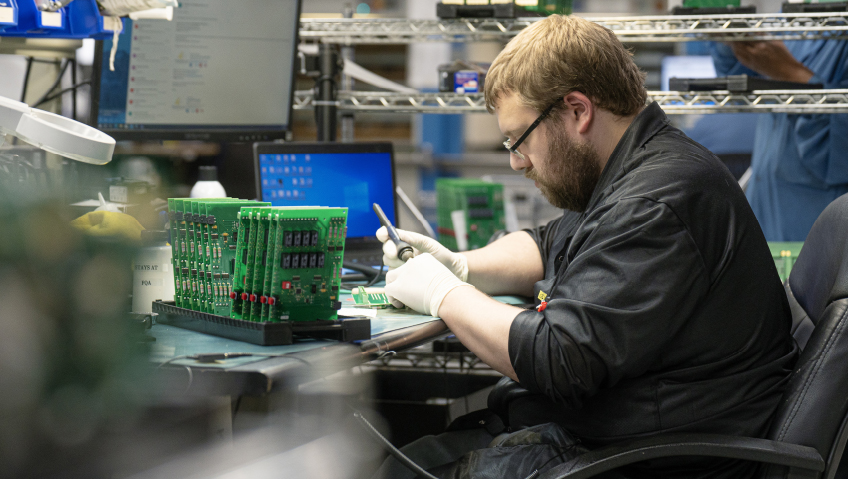
Today, PTG Electronics delivers fully integrated electronic manufacturing services, supporting original equipment manufacturers (OEMs) across a wide range of industries. Its capabilities span the entire production lifecycle, from printed circuit board assembly to full electromechanical box builds.
The company operates four SMT production lines along with a suite of semi-automated assembly and testing systems. These allow PTG to rapidly place, solder, inspect, and validate electronic components with exceptional consistency and accuracy.
Beyond board-level assembly, the company offers a full suite of services including programming, functional testing, environmental coating, and turnkey box builds, delivering fully assembled and shipment-ready products. This end-to-end manufacturing approach reduces complexity for customers while ensuring quality and accountability throughout every stage of production.
Equally important is PTG’s experience as an OEM of medical training products, which gives the team unique insight into customer expectations. “As a successful OEM of medical training products, we understand firsthand what clients need from their electronic manufacturing service provider,” says Wasserman. “That perspective drives our focus on quality, efficiency, attention to detail, and excellent service.”
Indeed, PTG’s evolution over the past two decades has been driven by continuous investment in technology. What began as a hand-assembly operation is now a digitally connected manufacturing ecosystem. “We didn’t even really have automated equipment when we first got going,” says Wasserman. “Now we have four SMT lines and a whole complement of semi-automated equipment for assembly, testing, and box builds.”
The company has also begun integrating artificial intelligence into its operations, starting with AI-based quoting systems that streamline pricing and accelerate response times. Future plans include deeper system integration, allowing real-time data sharing across departments and automating data entry processes. “Soon we’ll be able to pull data faster and increase accuracy significantly. It’s going to save a tremendous amount of time,” shares Wasserman. Rather than viewing automation as a threat to employment, PTG sees technology as a way to enhance human capability and improve quality.
Another cornerstone of PTG’s operational philosophy is continuous improvement, not only in processes and technology, but also in people. For the past several years, the company has partnered closely with the Michigan Manufacturing Technology Center (MMTC) to strengthen workforce training and leadership development.
MMTC supports PTG by providing access to grant opportunities and leadership development initiatives. Recent collaborations have included supervisory training and advanced problem-solving courses designed to empower frontline employees.
“We’ve sent four people in the last year to supervisory training to understand leadership qualities, how to manage people and navigate different personalities,” says Wasserman. “We also use problem-solving courses that improve quality and operational efficiency. These programs give our people tools to make better decisions and reduce risk on the plant floor.” By investing directly in employee development, PTG builds a more capable and engaged workforce, one that can adapt quickly to new technologies and evolving customer demands.
Perhaps the most defining characteristic of PTG Electronics is its unwavering commitment to partnership. Rather than transactional manufacturing relationships, the company emphasizes long-term collaboration and mutual success. “One of our core competencies is truly taking a partnership approach,” emphasizes Wasserman. “We invest in our customers as if they are an extension of our business.”
This philosophy, rooted in the company’s family ownership, guides everything from engineering support to quality assurance. PTG prioritizes long-term outcomes over short-term margins, believing that sustained success comes from consistently delivering value.
The results speak for themselves. PTG’s longest-standing customer relationship spans 28 years, while its top clients have remained loyal for more than 15 years.
“We don’t take shortcuts,” says Wasserman. “We support our customers even when it’s not the easiest thing to do, because we know that if they succeed, we succeed.”
As reshoring efforts gain momentum across the United States, PTG finds itself well-positioned to benefit from a renewed emphasis on domestic manufacturing. All its production takes place within its U.S. facilities, allowing customers to maintain tighter supply chain control while reducing risk and improving responsiveness.
“There’s been a shift back toward manufacturing things in the United States,” Wasserman explains. “We only build here in America, and we’re very proud of that.”
Looking ahead, PTG has set an ambitious goal: doubling the size of the business within the next three to five years. Central to this strategy is expansion into high-reliability sectors, particularly aerospace. The company is currently pursuing AS9100 certification, which will qualify it to manufacture electronic systems for aerospace applications. This strategic move complements PTG’s existing strengths in the medical, industrial, and advanced technology markets, further diversifying its customer base while reinforcing its reputation for quality and precision.
As PTG enters its second generation of family leadership, Wasserman is keenly aware of the balance required between honoring legacy and embracing innovation. “We never want to lose that customer-first relationship mantra,” he says. “At the same time, we need to be quicker and more open to evolution and change.”
This stance informs PTG’s approach to AI integration and operational modernization. While the company may have entered some digital initiatives later than others, its leadership is now firmly committed to staying ahead of the curve. And, alongside its technological sophistication, PTG remains deeply grounded in its family values. The company culture emphasizes respect, accountability, collaboration, and pride in craftsmanship.
With 65 employees across two facilities, headquarters in Ottawa Lake, Michigan, and a secondary site in Maumee, Ohio, PTG fosters a workplace environment where individuals are empowered to grow and innovate. That human-centric approach not only strengthens internal culture but also translates directly into customer outcomes, creating a cycle of trust, loyalty, and excellence.
As PTG Electronics charts its course forward, the company stands at the intersection of tradition and transformation. With advanced manufacturing capabilities, a growing digital presence, expanding workforce development initiatives, and a renewed brand identity, PTG is positioned to play a leading role in the future of American electronics manufacturing.
Its journey, from a modest hand-assembly shop to a technology-driven, high-reliability manufacturing partner, serves as a compelling example of how thoughtful leadership and unwavering values can shape lasting success. For Wasserman and the entire PTG team, the mission remains clear: deliver exceptional quality, build enduring partnerships, and engineer solutions that empower customers to thrive in an increasingly complex world.