Striving to expand the wine business in Washington State through marketing, communications, research, and education, the Washington State Wine Commission (WSWC) has steadily increased demand for Washington wine locally, nationally, and internationally—and is looking to do even better.
Also involved in these efforts are WSWC’s industry-driven Research Program and the advanced WSU Wine Science Center, a convincing symbol of the industry’s focus on the future.
A state government organization that represents all of the state’s licensed wineries and grape farmers, the WSWC was created in 1987 and is funded nearly exclusively by the industry through assessments based on grape ($12/ton) and wine sales (< 2 cents/bottle).
Representing a vibrant industry
“We represent every licensed winery and grape grower in Washington State,” explains Executive Director Kristina Kelley. “We’re not a membership organization; we’re part of the Washington State Department of Agriculture, guided by an appointed board and supported by assessments, not membership dues.”
The 13 members of WSWC’s board represent the industry, its wineries from small to large, and all growers small and large in both the east and west of the state.
“We have a cross-section on our board that represents a snapshot of our industry, focused on marketing communications, knowledge, and viticulture research,” says Kelley. “It’s really about building positive awareness of the Washington State wine industry, generating stronger demand for our wine, and making sure we’re addressing the health of our vineyards.” It also means addressing the needs of oenology (winemaking) and driving the growth of Washington State wine production through marketing and research.
Operating in the second-largest wine-producing state in the U.S., behind only California, the WSWC works closely with many fellow agencies and producers, including those in British Columbia, as it did during the catastrophic freeze of 2024, with Washington selling its grapes to its British Columbia colleagues.
Sustainable WA up and running
Sustainability is another vital component of the Commission’s work, and Sustainable WA, a stringent, scientifically based third-party certification program introduced in 2022, guarantees that Washington vineyards are grown and tended to sustainably, with consideration for the environment and the people who grow each grape. Sustainable WA wines are just now coming into the market, with about a third of the vineyards in Washington certified through the program. Wines can carry the Sustainable WA logo if they are made with at least 75-percent certified grapes.
To simultaneously maintain the health of agricultural and urban watersheds for native salmon, critically important to Washington State, Salmon-Safe, a prominent ecolabel in the United States, now offers dual certification to vineyards.
Kelley further clarifies when speaking on the vineyard certification, “It’s about managing what you’re doing in vineyards, inputs you’re using, and environmentally sound decisions.” Kelley adds, “What we have now is very much geared toward the agricultural portion of it, so protecting watersheds, soil health, and low-input farming techniques, which will help us as we think about the future of our industry.”
A sustainable future for the outstanding wine emerging from Washington’s vineyards also necessitates adapting to climate change to maintain the health of the vineyards and establishing a process to help educate growers on sustainability, undertaken in partnership with the Washington Winegrowers Association.
The human element
Another important aspect of Sustainable WA is the human component—how vineyards are treating their employees and the broader community, says Kelley. Certification of a vineyard includes interviews with its employees to ensure they receive adequate care through sound working conditions, proper training, fair compensation, and safety protocols.
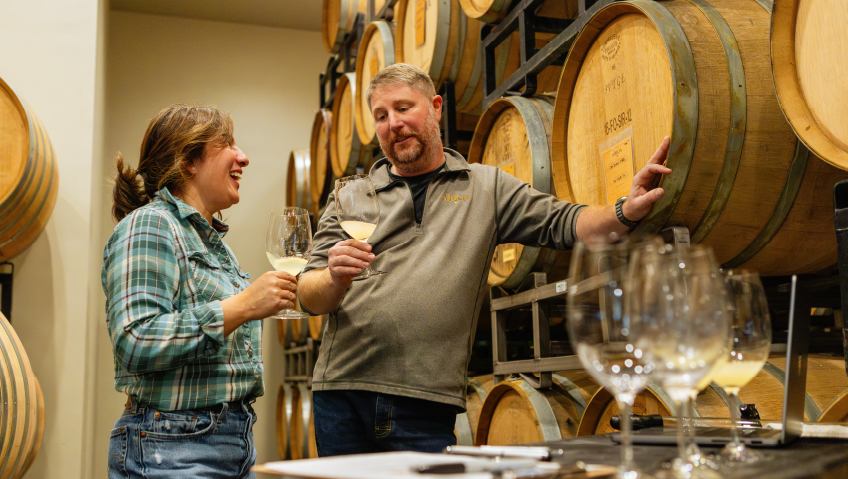
That care and concern also extend to vineyards located beyond the immediate area. “Washington State is very collaborative,” Kelley says. With the bulk of the industry located on the other side of the Cascade Mountains in Eastern Washington, joint efforts are key. “You see this great collaboration between those in Eastern Washington and Western Washington,” she says. “You’ll find winemakers working together to assist with equipment, knowledge, and a helping hand.”
The Commission itself collaborates with other agencies, including Washington State, the Washington Winegrowers Association, the Washington Wine Institute—its policy and advocacy group—Auction of Washington Wines, the Washington Wine Industry Foundation, and several regional associations. Quarterly, the regions come together to decide how to jointly address the most pressing issues in the industry, not just between wineries and vineyards, but also between organizations and various agencies, Kelley says.
“We don’t feel this competitiveness you might see in other wine regions. We identify as Washington winemakers and winegrowers first, and then who’s larger or smaller second. That’s something I find unique, having been in this role for two and a half years and spending the bulk of my career in other wine-producing regions.”
This willingness to help others when needed is indeed something special, she adds.
Wine for a new generation
Looking ahead, along with climate challenges, a downturn in the global wine market is one ongoing concern. Whether due to a generational change, consumer preferences, or economic constraints, people are drinking less, or they’re reaching instead for the plethora of canned, ready-to-drink cocktails and hard seltzers.
“It’s not just Washington; it’s across our wine industry as we evolve to meet the needs of this generation as they come into wine,” Kelley says. “But we see this as cyclical and something that gives us an opportunity to size our business and make sure we’re producing the best wines in the best regions with the best varietals. It gives us a chance to reevaluate what we’re doing here in Washington.”
Whether it’s addressing agricultural challenges such as pests, climate, or damage from smoke, or making sure marketing and sales are as effective as they can be, working closely with researchers is vital and part of WSWC’s ongoing relationships with Washington State University, UC Davis, and Oregon State University.
That said, upholding and continuing to build Sustainable WA will go a long way to ensuring the health of the wine industry for years to come. “It’s something we really needed to do, not only for our industry, but it’s also becoming more of a client requirement,” Kelley says, noting that this is particularly true in the export markets and with certain trade customers in the United States. “They want to know, ‘what are you doing for sustainability? Do you have a certification process for sustainability?’ Those are the things we’re seeing.”
This sense of camaraderie, collaboration, and commitment to working well with others is also a point of pride for the WSWC, particularly during a time of downturn across the wine industry. “It’s an accomplishment for all of us within our industry that these times have really made us reach out and work more closely with our partners,” Kelley says.
Spreading the word
Additionally, in an effort to ensure that Washington State wines are being recognized, inviting journalists and respected wine critics to participate in tastings has been very effective. The WSWC recently hosted 14 media representatives from the Czech Republic, Slovakia, Poland, the UK, Korea, and Japan at a time when concerns are being raised about the export market’s ability to pivot.
“Bringing journalists here to experience Washington State and then working closely with media—whether it be media in academia that covers research, or whether it be lifestyle media—really demonstrates our comprehensive communication plan,” Kelley says.
Education is also important, and something the WSWC has done well, she adds. As the industry and the world at large emerged from COVID, negative effects on retail and the on-premises environment included the loss of significant knowledge about Washington State wine, particularly when restaurants were shut down. Now, bringing back education and teaching about Washington State wine through dedicated team members—whether working with the Institute of Masters of Wine or with a Master of Wine (MW)—is a priority.
“We make sure people know how to sell Washington State wines. We’re a unique growing region; we have 85-plus varieties that are doing well, and 21 different American Viticultural Areas (AVAs),” says Kelley. “A big focus is about making sure people understand how to share that information with consumers.”
Goals for the coming years include building national and international recognition of Washington State wines and ensuring that locally, the WSWC maintains and even increases support for wineries and the growing community.
“How do we ensure that if a restaurant has local produce, seafood, and beef, they’re [also] supporting our local wine industry?” Kelley asks. “We’re working right now to ensure that if you’re in a restaurant and you come into the Pacific Northwest, you’ll see a section listing Washington wines available by the glass.”
At the national level, the WSWC is building awareness, both nationally and internationally. “We have our fingers on the pulse of so much within our industry, and it’s really rewarding,” Kelley says. “It’s rewarding to be able to lead this organization and work with other leaders within our industry to make sure Washington statewide is healthy, thriving, and growing. All this is incredibly important to the work we’re doing here at the Commission.”