
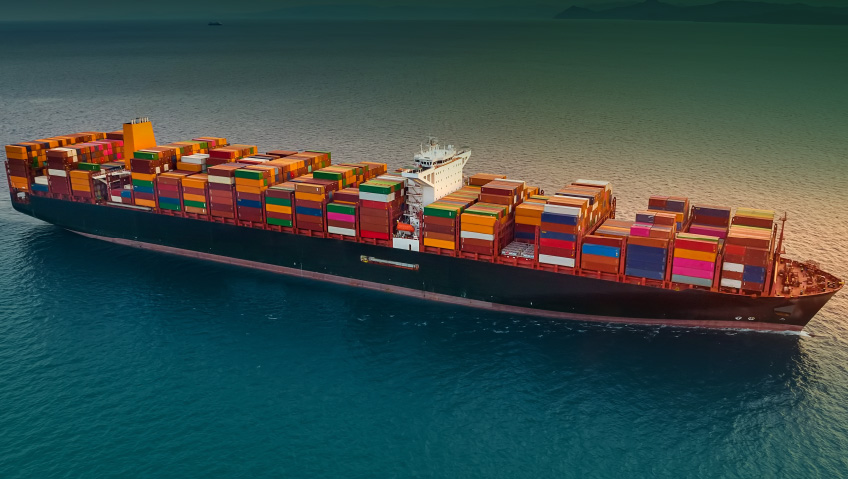
Over the last five-plus years, the global market has faced unprecedented challenges due in large part to forces beyond its control, and those circumstances continue to wreak havoc on the supply chains upon which it relies.
From the worldwide disruption set in motion by the COVID-19 pandemic to ongoing geopolitical tensions and tariff-fueled uncertainty, the global market and its deeply integrated supply chains have had their vulnerabilities laid bare, necessitating a period of adaptation to face these challenges head-on.
In a 2021 article for the Financial Times, authors Brooke Masters and Andrew Edgecliffe-Johnson describe how what was once a “just-in-time” system, designed to anticipate and meet market demand, has evolved into one focused on “just-in-case” scenarios that seek to mitigate risk and prepare for worst-case outcomes in order to remain viable long-term.
A system built on efficiency
The very nature and function of supply chains are rooted in efficiency, quality, and competitive cost. As the global economy became increasingly interconnected and interdependent, supply chains grew more complex, and so too did their management, giving rise to an entirely new term and discipline for the coordination of sourcing and supply.
The term “supply chain management” was formally coined by Keith Oliver nearly 50 years ago when he was discussing the integration of materials, information, and products as functions of a business’s operations and profitability. Since then, greater effort has gone into understanding and optimizing these relationships and commodity flows. Today, supply chain management no longer treats logistics and inventory management as separate functions, but rather as component parts of a cohesive, integrated business system. As a result, it has become a significant industry with considerable untapped potential.
According to a report by Monika Darandale and Eswara Prasad published by Allied Market Research, the supply chain management market’s value reached $35.7 billion last year, with expectations that it will grow to $91 billion by 2034.
Part of the reason for this growth is the sector’s capacity to adapt to challenges. Currently, the global supply chain is undergoing one of the most significant periods of transformation in its history—one heavily influenced by rapid technological advancement and a reorganization of global operations and relationships.
Survival of the fittest
During times of challenge, even the smallest competitive advantage can be monumental. Without question, efficient supply chain function is paramount to an operation’s performance and profitability. Operations that elevate supply chains to a strategic function, through the creation of interdepartmental councils comprising Finance, Operations, Procurement, Compliance, and IT, can leverage that structure to develop comprehensive solutions that optimize the flow of goods and strengthen the trade relationships central to their success.
This requires internal capacity to monitor and forecast, as well as reliable partnerships with suppliers and logistics providers who understand their role in their customers’ operational efficiency.
To build that capacity, significant investments are being made in automation, artificial intelligence (AI), and the Internet of Things (IoT), reducing reliance on error-prone and costly manual labour at a time when skilled workers are in high demand and short supply. From early technologies like the forklift to AI-driven tools such as IoT sensors, GPS, and real-time visibility software, technology has long empowered the ability to accurately forecast supply and navigate ever-changing regulatory environments.
Technology also enables the collection of actionable data from which informed decisions can be made, resulting in more resilient, agile, and ultimately profitable supply chains.
Growing closer to home
One of the greatest lessons of the pandemic was the exposure of deep vulnerabilities in the highly integrated global supply chains upon which companies and countries depend. Bottlenecks and the inability to satisfy “just-in-time” market expectations demonstrated how quickly these complex global networks could be disrupted and sparked a push for reinforcement through stronger local and regional capacity.
Global economies of scale certainly offer more competitive pricing and access to materials that cannot always be replicated locally or regionally, but local and regional networks help insulate supply chains from geopolitical instability, climate risks, extreme weather events, and the rising costs of transportation, fuel, and labour.
Particularly at a time when tariffs and deteriorating geopolitical relationships continue to threaten supply, there is growing momentum to re-shore and near-shore operations to strengthen local and regional footprints. This is no easy task, however, especially for a country like Canada, where regional cohesion is under strain. With the future of trade agreements like the Canada-United States-Mexico Agreement (CUSMA) in question, decision-makers are tasked with identifying new market horizons and new supplier relationships to diversify and strengthen their position.
With a focus on critical minerals, technology sectors, and agri-food export diversification, Canada is seeking to move beyond traditional markets and secure its economic future through new partnerships in the Indo-Pacific, Asia, and Europe, while bolstering the national economy through strategic investments in local capacity.
A path forward
Times of challenge present a valuable opportunity to strengthen existing trade relationships and reevaluate suppliers and logistics partners. Comfort and complacency can breed inefficiency, which means decision-makers at all levels must remain vigilant, plan for the worst, and be prepared for any scenario.
Resilience can be built into operations through financial and insurance risk mitigation, sustainable practices that support long-term outcomes, and a consistently proactive approach. Contingency plans and buffer stock are no longer optional; they are a requirement.
Ultimately, operations that adopt a framework of prevention, preparedness, response, and recovery (PPRR) are more likely to prevail, regardless of what supply chain challenges emerge, especially when they are tech-enabled and guided by knowledgeable decision-makers. Equipped with data, empowered by strong relationships across local, regional, national, and international supply chains, and guided by a strategy that supports nimbleness and agility, operations can withstand today’s challenges and mitigate those that may arise tomorrow.