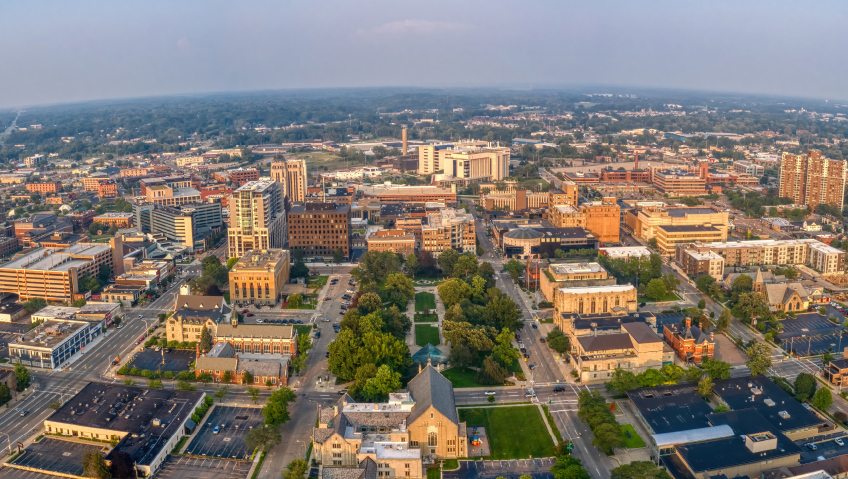
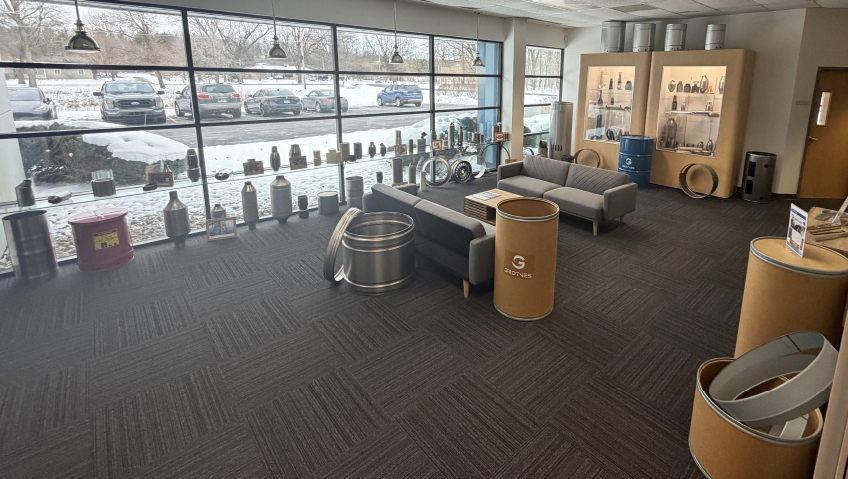
Over the past two years, Grotnes (pronounced ‘Grote-ness’) has launched a series of initiatives based around artificial intelligence (AI), customer service, and its product line. Headquartered in Niles, Michigan, with a heritage going back to the 19th century, the company manufactures integrated metal-forming cells and related equipment. Since we last spoke in December 2023 for Manufacturing in Focus, the company has also relocated some operations and welcomed the first graduate of its apprenticeship program.
Arguably, the biggest new development has been the company’s initiative of pre-engineered, configured-to-order (CTO) products to complement its customized solutions.
For Grotnes, CTOs offer multiple benefits including “faster delivery times, common platforms of parts, and spare parts that can be used across different models,” explains Vice President, Jim Zielinski. That said, customer specs sometimes demand a tailored approach, which is why Grotnes will never abandon custom work. “The custom side will always be part of our business. It’s our DNA… but the organization is trying to align itself around repeatable platforms,” he says.
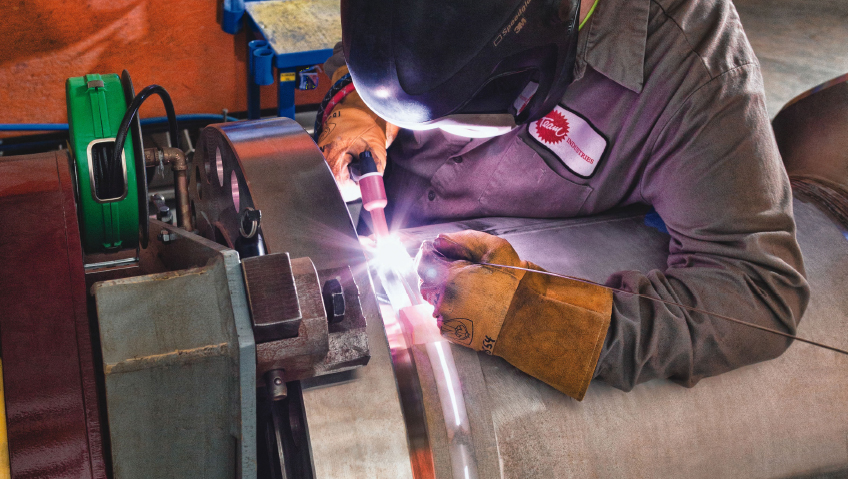
Grotnes continues to build machines for four main technologies: expanding, shrinking, roll forming, and spinning. Expanding processes involve shaping metal parts for pipe couplings, jet engine components, metal containers, and the like. Shrinking entails the exact opposite procedure and aims to reduce and shape parts for motor frames, conveyor rolls, and exhaust components. Roll forming involves bending hoops of metal, while spinning is a metalworking technique based on mechanical rotation. Closing tools, used to seal or close items such as pail lids or the tabs on large-size paint cans, are also becoming a growing category.
Monumental as the introduction of CTO solutions might be, there have been other big changes at Grotnes as well. For a start, the company is going through “a digital transformation” that entails “the leveraging of AI where it makes sense in the business,” says President Mike Walker.
To this end, the company will soon launch Grotnes’ AI assistant, a tool that could be compared to Amazon’s AI-enabled, voice-led personal assistant Alexa, but for internal use only. “There’s no gateway to the outside world. It’s utilizing AI’s ability to search our databases, our files, our drawings, our pdfs, to be able to respond quickly,” explains Walker. “We’re very careful right now to adopt it where it really adds value to the company… We’ve spent a significant amount of time really focusing on, ‘How does it add value and help our customers at the end?’”
It is quite the leap for a firm that traces its roots to 1898 and a decision by one Charles Grotnes to open a machine works operation in Chicago. That business initially focused on manufacturing metal rings to hold barrel staves together. The company founder and namesake invented a time-saving machine to shape and stretch these metal rings to an appropriate size, and things took off from there.
At present, Grotnes serves the oil and gas, general industry, automotive, aerospace, rigid packaging, forging, and tanks and appliances sectors. The company uses the term ‘tanks and appliances’ to characterize its work for the power distribution and appliance markets with the tanks in question being metal storage containers.
“We do metal forming machines for large tanks that are typically used for isolation transformers, so there’s the power distribution angle, and then, from the appliance standpoint, tanks for things such as water heaters, drums for washers and dryers, dishwashers, and things like that,” Zielinski explains. Over the past year, aerospace and automotive generated the most business, a pattern that is likely to hold steady in 2026, he adds.
He has noticed something of a resurgence in the market for catalytic converters, the devices that reduce harmful exhaust emissions from combustion engines. Since large, commercial trucks would require huge electric batteries, thus limiting payloads, concerns about battery size have stalled the drive toward vehicle electrification in certain sectors. With gas and diesel-powered trucks still dominating, the demand for catalytic converters remains high. This trend is good news for Grotnes, which has been a pioneer in making machines that are used in catalytic converter production.
The company has maintained its ISO 9001:2015 certification and is gearing up to get certified when the new ISO standard (9001:2026) is released later this year. As befitting an ISO-certified company, quality assurance procedures here are rigorous. The company utilizes a coordinate measuring machine and other inspection equipment to ensure that all parts are shaped and sized correctly. Completed machines are subjected to rigorous factory acceptance testing procedures at the plant. If the machine achieves these benchmarks, it gets shipped to a customer, and the system is then put through site acceptance testing at the client’s worksite to determine that everything is in perfect working order.
“ISO is a very big part of our business and really drives the quality in our organization. We embrace that in a big way, especially the continuous improvement side of it. Every employee in our organization is able to submit improvement suggestions regardless of their position in the company,” says Walker.
The advent of a configured-to-order line is further proof of the company’s commitment to continuous improvement, he continues. Offering pre-engineered solutions will enable Grotnes to “focus on a standard design and continue to refine it for our customers’ needs and bring additional value by bringing costs down and benefits up,” he explains.
Company officials are well aware that excellent equipment requires servicing and upkeep. As such, the team kicked off a preventative maintenance initiative called the Grotnes Service & Spares Club last year. Customers who join the club receive discounts on spare parts, labor, training, phone and remote support, and other maintenance measures. The overall aim is to keep client equipment in excellent condition.
At the time we last spoke, the company maintained sales and service branches in Monterrey, Mexico and Atlanta, Georgia. While the Mexican branch is still flourishing, the Atlanta operations have been relocated to Niles. This transition has drastically reduced turnaround times for some products; solutions that might have taken a month to produce and ship in Atlanta now take maybe 48 hours, according to Walker. The company continues to ship products around the world and works with European sales partners as well.
Grotnes also runs a facility called Formitt Metal Labs as well as an in-house machine shop. Formitt Labs does prototyping and feasibility testing for customers as well as research and development. Recent equipment purchases for the machine shop, meanwhile, include a lathe and a wire electric discharge machine. The company’s five-year growth strategy includes the possibility of offering machine shop services as a separate business component for customers, a strategy that would build on already existing competencies. “We have customers who are not interested in a capital purchase and just ask us to do the production for them,” notes Zielinski.
In terms of promotion, Grotnes regularly attends trade shows. Last year, the company took part in FABTECH USA in Chicago—the top conference for fabricating, finishing, welding, and metal forming in North America, as well as Fabtech Mexico in Monterrey, Mexico. It also showcased its metal forming skills at the 40th Space Symposium, a major aerospace event which took place in Colorado Springs, Colorado in April 2025. The company has revamped its website as well, with a view to adding updates regarding its configured-to-order (CTO) offerings.
All told, roughly 43 people work at Grotnes. Beyond the requisite education levels and skills, the company seeks applicants who can think on their feet and offer creative solutions. Personnel must be prepared to pivot in the face of challenges, think outside the box, and adapt to changing circumstances since “ours is a pretty fast-paced technology business,” says Zielinski.
Current challenges include dealing with the rising cost of materials, due in part to tariffs imposed by the United States and other nations. That said, “The biggest challenge for us continues to be the ability to hire the right people, and secondary to that, finding them. Every position in our company is really a skilled position,” states Walker.
To address this issue, the company instituted a four-year apprenticeship program which blends hands-on training with classroom learning. Apprentices attend evening classes at Lake Michigan College, which is based in Benton Harbour, Michigan and has a campus in Niles. The program just graduated its first apprentice, who specialized as an electrical technician, and apprenticeships are also available for machine builders and machinists. There are ongoing discussions about expanding the program to include engineering.
For a near-term forecast, Walker circles back to CTOs and AI. “Completing our journey on the CTOs is really critical to us,” he shares. “It’s not something that’s going to happen overnight; it’s not something that’s quick, because it’s got to be right.”
As for artificial intelligence, “We’ve come up with some pretty interesting initiatives,” he says. “Three years from now, I think we’ll [have a lot] to talk about… We believe it’s going to help us tremendously.”