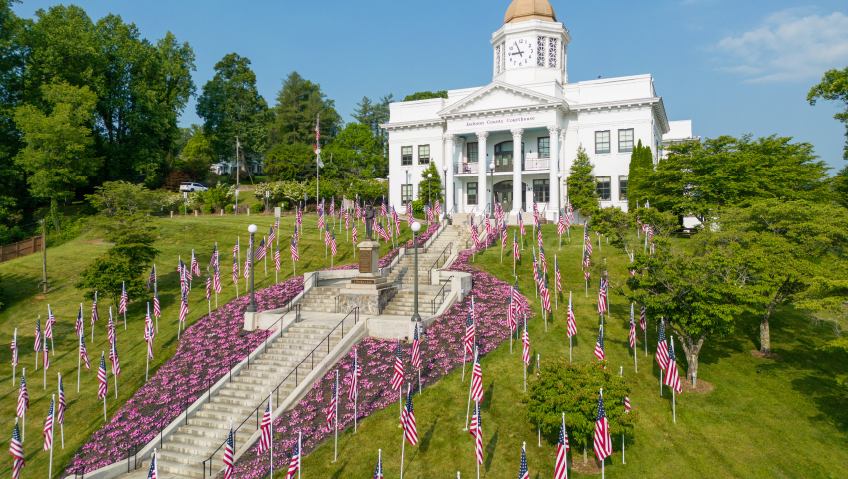
There is plenty to discover in Jackson County, North Carolina. Located near the Blue Ridge and Great Smoky Mountain ranges, the county is conveniently accessible from several highways and situated within a 150-mile radius of the cities of Charlotte, North Carolina; Greenville/Spartanburg, South Carolina; Atlanta, Georgia; and Chattanooga, Knoxville, and Johnson City, Tennessee.
In addition to several thriving unincorporated communities, including Cashiers, Cullowhee, and Whittier, the county is also home to four incorporated towns—Dillsboro, Sylva, Webster, and Forest Hills—and more than 185 recognized summits, 200 rivers and streams, stunning scenery, unmatched outdoor activity, and a beautiful setting for cultural and economic interaction.
Home to more than 40,000 people, the county’s population is predicted to grow steadily throughout the next 10 years, and according to the most recent census data, has increased by 30 percent since 2000, making Jackson the county with the greatest rate of growth among the seven counties that comprise the Southwestern North Carolina Mountains.
“Our goal is to build a more diverse economy in Jackson County, one that creates new opportunities for businesses to grow and for our residents to build meaningful careers close to home,” says Tiffany Henry, Director of Economic Development.
Central to that strategy is the Jackson County Business Campus, a roughly 42-acre former industrial property off Skyland Drive. The project represents Jackson County’s first intentionally developed business and industrial campus, creating new opportunities for business expansion, recruitment, and economic diversification. The property was also selected for the Economic Development Partnership of North Carolina’s (EDPNC) SelectSite program, recognizing its potential for industrial development. “Sites like this are extremely rare and difficult to find, especially in the mountains,” says Henry.
A relatively flat site, it is fully rail-served and will provide the county with something it has never had before. “It’s a place where we can proactively recruit businesses rather than waiting for an appropriate property to become available,” Henry says. “We’re focusing on right-sized businesses and industries that fit Jackson County, particularly manufacturing,” she explains. “We want to create opportunities for existing businesses and attract new employers that can provide quality, higher-wage careers for our residents.”
The county has entered into an economic development agreement with The Ruddell Group as its private development partner, with the goal of constructing buildings that will create much-needed, market-ready industrial space.
The development is also expected to attract a range of businesses and industries to the area. “Ruddell primarily targets advanced manufacturing, assembly, specialty logistics, and B2B companies,” says Ruddell Group’s founder, Dean Taitz. “That could be HVAC that needs 20,000 square feet or a custom cabinet manufacturer; we’ve seen it all, and those clients really like the product we put out.”
Taitz is eager to see development move forward and hopes to secure an early tenant, helping build momentum for the campus.
“It would be a huge win, providing great momentum for the area,” he says. “It’s a testament to how, when local government and private developers come together, we can achieve a whole lot more being on the same team. It’s also a very interesting concept, especially in real estate development. I’ve got to commend Jackson County for being on the cutting edge.”
“An important part of this project is that the county is retaining a portion of the property for a proposed workforce training center in partnership with our Southwestern Community College,” Henry explains. “That creates a unique opportunity to bring business and workforce training together on the same campus. Our vision is to connect employers with the talent and training resources they need while creating new career pathways for our residents.”
Taitz also sees the site’s relatively flat terrain and existing rail access as significant advantages in a region where industrial development can be so challenging. “To find that in Western North Carolina is a huge incentive in itself,” Taitz says. “If you need to be in Western North Carolina and need a 100,000-square-foot building, this is one of the only sites that we could build it on easily and cost-effectively that’s rail-served.”
“It’s an incentive to the right kind of people who know how tough it is,” he adds. “If you want to serve the area, be close, and reap all the benefits there, this is a site you can fit your business on.”
With access to both Western Carolina University and Southwestern Community College, Jackson County is well positioned to connect businesses with workforce training and education resources.
“We have an interesting mix right here,” says Henry. “Having this workforce training center on this property will allow us the opportunity to provide hands-on training space for programs such as construction, electrical, plumbing, or other advanced trades needed in this space, and we hope will respond to the needs of future employers.”
It will also help set Jackson County apart, drawing in both business and employees. “I’ve never worked on a project where we can train all the employers’ workers across the railroad,” adds Taitz. “They’re basically on the same site, which is really powerful.”
Of course, with extra jobs and employment comes the often-challenging task of providing adequate, affordable housing, an issue discussed nationwide and one that Jackson County is tackling head-on. “I’m excited that we’re not just studying these problems anymore; we’re putting projects on the ground,” says Henry. “In Jackson County, we’ve been working on a multi-partner development bringing workforce homeownership, workforce rental housing, and affordable senior housing.”
Webster Village is a collaborative housing initiative bringing together Jackson County, Mountain Projects, Western Carolina University, and Givens Communities. The development will include workforce homeownership opportunities, workforce rental housing, and affordable senior housing, addressing several different housing needs within the community. Jackson County has helped coordinate the partnership and secure funding for the infrastructure necessary to support the development. The Givens affordable senior housing component is scheduled to break ground December 8, with completion anticipated in 2028.
“We’re moving beyond studying the housing challenges and taking real steps to create more housing opportunities in Jackson County,” Henry explains. “We’re a small rural county, and that makes it really challenging. I’ve never felt like I could really, honestly recruit a business until we addressed some of these fundamental things: housing, childcare, broadband, and workforce training.”
Those are precisely the issues she has been working on diligently for the past five years, with housing in particular well on its way. “We’re also doing some significant work in the childcare space with a project we’re really excited about called Webster ChildPlex. It’s an innovative shared-facility model designed to help independent childcare providers open and operate their own classrooms while sharing common spaces and resources.”
A county-owned space being developed around a shared facility model to expand childcare capacity and support providers, the ChildPlex is akin to a “childcare incubator,” providing licensed classrooms, support, and resources needed to start a classroom while incubating and growing into a center model.
“I can’t expect staff to move from an existing center to the one that I’m trying to open, ultimately closing a classroom to open another one,” Henry says. “Then I’m shuffling kids around, and I’m not solving a problem. This, to me, is solving a problem at a grassroots level. We’re working on the fundamental building blocks, if you will, of economic development, this being one of them.”
It’s certainly a vital one, along with the need for broadband, she adds. Broadband infrastructure is being actively deployed across the county, with close to 95 percent of address points either served or funded for broadband service.
With training, education, and housing all making headway, Jackson County boasts a multitude of other advantages, including stunning outdoor spaces to draw residents, tourists, and businesses alike. “Our quality of life is probably one of our greatest competitive advantages because we don’t have to convince people that Jackson County is a great place to live,” Henry says. “From fishing and hiking to public lands wedged in between the Great Smoky Mountains National Park and the Blue Ridge Parkway, visitors and residents love it because we have a lot of those assets right here at our back door.”
These are coupled with vibrant small-town downtowns and communities that have their own unique identities. “You get all of the benefits of a rural community that is vibrant, and there’s a lot going on in them.”
The county also boasts a strong cultural heritage, with approximately 10 percent or more of its residents identifying as Native American, predominantly of Cherokee descent. The Eastern Band of Cherokee Indians, one of three federally recognized Cherokee tribes in the United States, is headquartered on the Qualla Boundary, which includes lands in Jackson and Swain counties.
Special events abound in Jackson County with Mountain Heritage Day and Greening Up the Mountains festivals and numerous community holiday events that bring a tremendous amount of art, music, and Appalachian cultural heritage to the region, while Whittier Heritage Grounds, a former industrial property that sat largely vacant for decades, is transforming into a community and event space that can host anything from festivals and markets to agricultural and youth events. “Plans for the property include a 48,000-square-foot open-air pavilion that will expand opportunities for community celebrations, agricultural events, festivals, and other activities,” Henry adds.
“It’s a unique project. Economic development in rural North Carolina looks very different than it does in our more urban neighborhoods, and this project is one of those.”
Henry has a close affinity for the county she has never left, growing up there and having attended both Southwestern and Western. “Jackson County has always been a place where I want to live, and I want people to want to live, and I’m invested in it because I know how special it is,” she says. “Our work now is making sure it’s a place where more people can build a career, raise a family, and create a future affordably. We’ve got to work on all of these different things so they can stay here.”
This also means increasingly looking at economic development as an ecosystem, she stresses. “We can’t talk about recruiting an employer without talking about where the employees are going to live and whether they can find childcare, have broadband, how we’re going to train the workforce—we’re trying to handle all of those collectively. That’s one element of our economic development strategy.”