In the heart of North Carolina, Randolph County has spent decades building a reputation as a manufacturing stronghold and today, under the guidance of the Randolph County Economic Development Corporation (RCEDC), the region is entering a new phase of growth defined by advanced manufacturing, workforce investment, and a deep commitment to the companies that call it home.
RCEDC is a nonprofit organization with a clear mandate in supporting the industries already rooted in the community while attracting new manufacturers to the county. It’s a mission with real stakes. Manufacturing accounts for roughly 25 percent of all jobs in Randolph County, making it a cornerstone of the local economy and a driving force behind the county’s long-term planning.
“We really focus on the industrial sector, and that is supporting the industry that is already based in our community as well as the attraction of new industry to Randolph County,” says Kevin Franklin, President of RCEDC. “It’s an important part of our local economy. We want to keep that healthy and thriving and make sure we’ve got plenty of opportunities for our residents.”
That dual focus of supporting existing employers while pursuing new investment shapes nearly everything RCEDC does, from its incentive structure to its day-to-day outreach. It’s an approach built on the understanding that economic development isn’t just about landing headline-grabbing announcements, but about sustaining the businesses already contributing to the tax base and employing local residents.
Randolph County’s industrial base spans a wide range of sectors—automotive, aerospace, plastics, food and beverage, metals, furniture, and textiles among them—but one sector is generating more momentum than any other right now. “The automotive sector is big, with Toyota batteries in production now in our community,” says Franklin.
Toyota announced its investment in the county in 2021, and the ramp-up has been substantial ever since. The company has committed to more than 5,000 jobs, with roughly 3,000 already on site. That growth is ongoing, and according to Franklin, it’s having a positive impact community-wide.
The scale of the investment is significant not only for the jobs it creates directly, but for the ripple effects it generates throughout the local economy, from suppliers seeking proximity to the plant, to service industries supporting a growing workforce, to the broader signal it sends to other manufacturers considering the region. A project of this magnitude tends to validate a community’s readiness in the eyes of other site selectors, and Franklin and his team are clearly aware of the opportunity that presents.
The Toyota battery plant sits on the Greensboro-Randolph Megasite, an approximately 1,800-acre property that Toyota owns outright, alongside with a handful of on-site suppliers. The megasite was central to landing the deal in the first place. “That was a pretty big pitch,” Franklin says of the site’s role in the negotiations.
Megasites of this scale are rare, and they typically take years of coordinated planning among state and local agencies to prepare for a project of Toyota’s size. Having land ready for an operation with this footprint was a critical piece of the puzzle and it’s part of the reason RCEDC continues to emphasize site readiness as a priority for future growth.
Ask Franklin what draws manufacturers to Randolph County specifically, and a few themes emerge quickly: workforce, quality of life, and a long manufacturing heritage that has left the region with a strong labor pool.
“I think they’re coming for the workforce. I think they’re coming for quality of life as well,” he says. “And because we have such a high concentration of manufacturing, we’ve got a high manufacturing quotient for many of the sectors that we’re bringing in. So that means there are resources, there are suppliers, and there’s workforce.”
That manufacturing quotient, a measure of how concentrated an industry is in a given area relative to the national average, matters to companies evaluating where to locate or expand. A high quotient signals an established ecosystem of workers who already understand plant environments and production schedules, and a regional identity tied to industrial work. For companies weighing the risks of standing up a new facility, that kind of ecosystem can meaningfully reduce ramp-up time.
Location plays a significant role too. Randolph County sits centrally within North Carolina and along the East Coast more broadly, with direct access to interstates 73, 74, 85, and future I-685. The county is also within reach of I-95 and I-77. “It’s really quite a convergence from a transportation standpoint,” Franklin says. For manufacturers, that convergence translates directly into logistical efficiency, meaning shorter shipping times to both suppliers and customers and easier access for the workforce commuting from surrounding counties.
Rail infrastructure adds another layer of advantage, with Norfolk Southern operating multiple lines through the county. “Not every community has rail access,” Franklin says, “so that provides some unique opportunities as well.”
For heavier manufacturing operations, or those moving significant volumes of raw materials and finished goods, rail access can be a deciding factor that highway infrastructure alone can’t replace. It’s a differentiator RCEDC leans on when pitching the county to industries with rail-dependent supply chains, such as automotive and metals manufacturers.
Despite its many strengths, Franklin is candid about the challenges RCEDC faces when it comes to available real estate. As a legacy textile, furniture, and tobacco community, Randolph County has a substantial inventory of older industrial buildings but many weren’t built with today’s manufacturing operations in mind. “We do sometimes struggle with availability of ready-to-go sites and suitable buildings,” he says. “For example, the ceiling heights typically are not what our manufacturing operations today are looking for.”
This is a challenge familiar to many legacy manufacturing regions across the country. Buildings constructed decades ago for textile mills or furniture production were rarely designed with the clear-height requirements or automation infrastructure that modern manufacturers now expect. Retrofitting older stock can be costly, and in some cases, it’s more economical for a company to build new than to adapt an existing structure.
On the site development side, the picture is mixed. Some properties are closer to shovel-ready than others, and Franklin tells us the county doesn’t currently have a fully prepared shovel-ready site on offer, though that could change quickly with the right end user. Indeed, site readiness has become a decisive factor for many manufacturers, particularly those on compressed timelines, and communities without shovel-ready inventory can find themselves excluded from consideration before negotiations even begin. RCEDC recognizes this gap and is prepared to move quickly to close it when the right opportunity presents itself.
The workforce remains one of RCEDC’s central priorities, and its partnership with Randolph Community College plays a key role in addressing it. “We have a great partnership with Randolph Community College, and of course North Carolina is known for its customized industrial training program,” which gives the county a strong tool for preparing workers to meet the specific needs of incoming manufacturers. “We are talking with the community college on a weekly basis,” says Franklin.
That weekly communication points to a working relationship built on a continuous feedback loop between the organization recruiting employers and the institution responsible for preparing the workforce those employers will hire from. When a new company signs on, RCEDC and the community college can move quickly to design training that matches the operation’s specific needs, rather than relying on generic programs that may not translate directly to the plant floor.
Randolph Community College can help train the local workforce, but of course wages and workplace culture remain firmly in each company’s hands. “What we can’t control is culture and wages,” Franklin says. “The companies that are really focused on providing the right type of environment for their employees and paying them fairly generally don’t have trouble finding the right kind of applicants.” RCEDC can help build the pipeline, but it’s ultimately up to individual employers to make the jobs at the end of that pipeline attractive enough to fill.
For manufacturers considering Randolph County, RCEDC offers a structured set of incentives designed to support both new entrants and companies already established there. Performance-based cash incentives, typically structured over a five-year window, form the backbone of the offering. RCEDC calculates anticipated new taxable revenue from a company’s operations and negotiates a portion of that back to the business over time.
“We also work closely with the state of North Carolina for grants and incentives at the state level,” Franklin says. “Some of those require matches from the local governments, and we participate in those.”
For companies eyeing vacant buildings that need upfitting, RCEDC has had success securing state grant dollars to support renovations, administered on a per-job basis. Training support is available as well, through customized grants developed in partnership with the community college. “We can put a plan together through the community college to help with that training even over a three-year period,” says Franklin.
This layered approach to incentives gives RCEDC multiple levers to pull depending on a company’s specific circumstances. Rather than offering a single, one-size-fits-all package, the organization tailors its support to the size and needs of each business, whether that’s a multinational automaker or a small manufacturer looking to expand its footprint.
RCEDC’s support doesn’t stop once a company sets up operations. The organization’s existing industry program, built around outreach and ongoing connections to resources, is one of its most important functions. “Let’s get the new company here and then continue to support them through our existing industry programs,” Franklin says.
That ongoing relationship is, in many ways, the quieter half of RCEDC’s work. Recruitment announcements generate headlines, but retention and expansion, keeping existing employers satisfied and growing, often matter more to a region’s long-term economic health.
On the smaller end of the scale, the City of Asheboro has recently introduced small business grants aimed at companies that may not qualify for larger state-level programs. “When they fall in that gap, if they’re growing, adding jobs, adding tax base, there’s an opportunity to capture some incentive dollars, grant dollars on a much smaller scale,” Franklin explains. That gap-filling function matters for a community like Randolph County, where not every employer is a Toyota-scale operation. Smaller manufacturers and family-owned businesses make up a meaningful share of the local economy, and ensuring they have access to growth capital, even in modest amounts, helps keep that segment of the industrial base healthy.
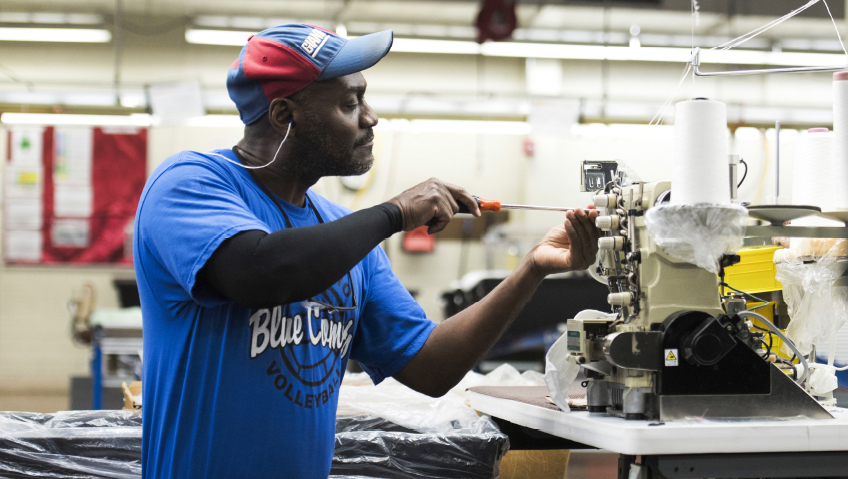
RCEDC sees the county’s manufacturing base continuing to shift toward higher-skill, higher-automation operations over the next five years, with particular opportunity in metals, plastics, and additional automotive-related industries. “We’re definitely moving in the advanced manufacturing direction—more automation, more highly skilled workers—which is beneficial because that means they’re receiving higher pay and better benefits,” Franklin says.
This trajectory mirrors a broader pattern playing out across manufacturing hubs nationally as automation reshapes the skills required on the plant floor and pushes wages upward for workers equipped to operate and maintain increasingly sophisticated equipment. For Randolph County, positioning itself at the front of that shift could prove to be a defining factor in the type of investment the region attracts over the next decade.
RCEDC operates with a small but dedicated team, with three full-time staff members and one part-time. Kevin Franklin leads the organization, with Crystal Gettys serving as Business Recruitment Director, focused on bringing new business to the county and working with property owners to bring new products onto the market. David Hursey serves as Existing Industry Director, interfacing daily with local industry to ensure companies have the resources and connections they need to thrive. Malynda Shumaker, working part-time, manages the organization’s financial operations.
Such a lean structure means each team member wears multiple hats, and it speaks to the level of coordination required to run an organization responsible for both landing large-scale investments and maintaining relationships with the county’s smaller, established manufacturers.
With a strong industrial base and a clear strategy for workforce development and incentive support, Randolph County—and the RCEDC team guiding its growth—is positioning itself for a new era of advanced manufacturing.