Ohio Mid-Eastern Governments Association (OMEGA) represents 10 counties—Belmont, Carroll, Columbiana, Coshocton, Guernsey, Harrison, Holmes, Jefferson, Muskingum, and Tuscarawas—in the east portion of the state. Working with local, state, and federal partners, OMEGA provides planning, funding exploration, research, and technical support to various groups and is a regional transportation planning organization for the area. The association’s goal is to improve economic conditions for the more than half-a-million people who reside in the 10 OMEGA counties; strengthening networks and prioritizing community stakeholders that range from elected officials and community leaders to workforce training providers and educational institutions.
“Our mantra is connecting communities through resources,” explains Dr. Vicki King-Maple, Executive Director of OMEGA, adding that throughout the region, the association offers “an extension of institutional capacity within the 13 cities, 99 villages, and 179 townships.”
The OMEGA region is based in Appalachia, a huge swath of land spanning over 200,000 square miles from the Deep South through to New York State. Like much of Appalachia, the OMEGA counties are renowned for their natural beauty, which includes rolling hills, deep valleys, dense woods, and extensive waterways. Yet for all this proximity to nature, the OMEGA area is also situated near major urban centers such as Cleveland and Columbus. The region has endured economic challenges in recent years, which the association and its partners are working hard to address.
“Our area, much like other areas in Ohio, had a few years of industrial decline. That was a really big challenge for our community. At the same time, it bred a resilience here in our community that is really contagious,” says Tiffany Swigert, Executive Director of the Coshocton Port Authority, an economic development resource center for Coshocton County.
This resilience and future-facing attitude is exemplified by a huge redevelopment project at the site of the former Conesville Power Plant in Coshocton County. Opened in the late 1950s by the American Electric Power Company, this coal-fired plant was a fixture for decades. At its peak, the facility employed hundreds of people, and its soaring smokestacks were considered local landmarks, but due to rising costs among other factors, the plant closed in April 2020.
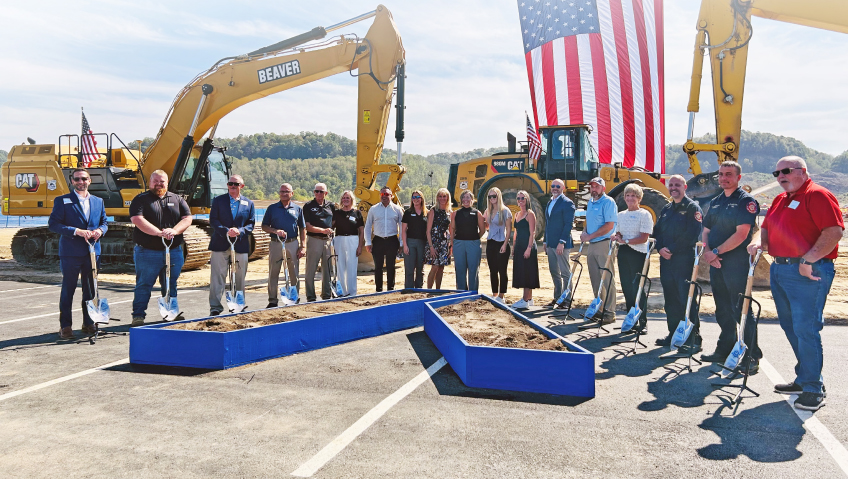
There are big plans now to revitalize the 2,000-plus-acre site, aided in part by $58.7 million the Coshocton Port Authority garnered from the All Ohio Future Fund, a statewide development program. A further $80 million has been invested in this endeavor by the Frontier Group of Companies, an industrial and commercial redevelopment firm that now owns the Conesville site. These funds are being used to remediate the land and upgrade water, sewer, and roadway infrastructure to transform the area into an industrial park to make it a hub for data processing, advanced manufacturing, and energy companies.
The Coshocton Port Authority also purchased a vacant building in the city of the same name to establish a venture called the Coshocton Collaborative. The collaborative offers co-working spaces with high-speed Internet and private rooms, a maker space with 3D printers, woodworking equipment, and other gear, and business incubation offices to give a boost to budding local entrepreneurs and creators.
The Port Authority paid for the building, in part, with grant money from the Appalachian Community Grant Program and a JobsOhio Vibrant Community grant, as well as the Coshocton Foundation and the Coshocton County Commissioners. The Appalachian Regional Commission (ARC) and the Governor’s Office of Appalachia (GOA) were also instrumental, as ARC is a federal commission that has distributed billions of dollars in grants and targeted investments to invigorate the Appalachian economy since it was founded in the mid-1960s. OMEGA helped the Port Authority obtain capital stack grant funding, as it is itself funded partially through ARC, the U.S. Department of Commerce’s Economic Development Administration (EDA), and state organizations, including the GOA and the Ohio Department of Transportation.
Over in Columbiana County, the Sustainable Opportunity Development (SOD) Center is doing similar work. Based in the city of Salem, the center is a non-profit entity focused on “traditional economic development,” explains SOD Executive Director, Julie Needs.
The center helps area businesses with site selection, grant research, expansion, retention, and workforce development, while the SOD training center hosts training sessions for local businesses, primarily in the manufacturing sector. Over the past eight years, more than 6,200 people have received training from outside facilitators.
Through the SOD Center, Salem houses Elevate Building Solutions, an administrative office created to fill a glaring gap. Salem and some surrounding communities lacked a municipal building department, forcing contractors to deal with the state building department, Needs recalls. A decision was made to offer a local alternative, and Elevate was launched in 2023.
Created through collaboration between Salem and the city of Columbiana, Elevate Building Solutions helps contractors with permits, inspections, zoning, and other regulatory issues. The focus is on commercial projects in Columbiana, Salem, and the Village of Leetonia, and residential services are also available for Columbiana. The results have been remarkable; a six-month average turnaround for plan review has been reduced to six days, says Needs.
While proud of these achievements, Needs is quick to credit outside collaborators for SOD’s success. “We couldn’t do what we do without an organization such as OMEGA as our partner,” she states. “Without the resources OMEGA provides, it’s not possible for us to do what we do.” To be even better positioned to offer assistance, the OMEGA headquarters is relocating into the heart of the region in New Philadelphia, Tuscarawas County.
Going forward, OMEGA and its community allies are very much in agreement on another point: economic development goes hand-in-hand with community development. “It requires cooperation and collaboration to build the robust, regional development ecosystems we are striving for,” King-Maple explains. “Ecosystems that foster job creation, entrepreneurship, economic growth, sustainable infrastructure systems, and scalable, people-centric models.”
The OMEGA team and its regional partners leverage and mobilize resources, and they demonstrate a unified voice through symbiotic efforts to create thoughtful solution strategies.
“I might be looking to attract a new employer to Salem. That employer won’t look to Salem unless we have the community assets that the workforce is going to want,” says Needs. This includes housing, retail, restaurants, parks and recreation, schools, and events.
To this end, a portion of the $31.6 million in recent funds OMEGA received from the Appalachian Community Grant Program is being dedicated to downtown improvements and building renovations in the city of Zanesville, Muskingum County. This county features business and industrial parks hosting clients such as the Dollar General Distribution Center, a logistics hub for retail outlets run by Dollar General Corporation, a Fortune 500 firm.
“We are incredibly proud of the momentum we’re seeing across Muskingum County. The growth, investment, and projects taking shape today are a direct result of strong partnerships and a shared vision for our future,” Muskingum County Commissioner, Melissa Bell, contributes. “We remain committed to building on that progress and continuing to bring meaningful opportunities, jobs, and quality of life improvements to our community.”
In neighboring Coshocton County, Swigert notes, “I can work my tail off to get a company to locate in this community, but if we don’t have a vibrant downtown and great parks and recreation and excellent schools, it’s not going to appeal to the families that are going to be working at those companies.”
Some communities in the OMEGA region, such as the city of St. Clairsville, were settled in the 1790s. With a population today of roughly 5,000 people, St. Clairsville has both a rich history and some structural challenges, a common combination in the region. “We’ve got a lot of towns that have 100-year-old infrastructure,” explains St. Clairsville Mayor, Kathryn Thalman.
As such, St. Clairsville is currently undergoing a major infrastructure upgrade involving a new sewer wastewater facility, among other projects. The mayor praises OMEGA, saying: “These people are exceptional. OMEGA has been a very integral partner for us, and I appreciate it.” She strongly supports collaborative development and has reached out to her fellow mayor in nearby Wheeling, West Virginia to discuss plans for economic growth.
“We want to bring industry back to this valley. It won’t be in St. Clairsville per se; however, it will affect this entire valley,” says Mayor Thalman.
Reindustrializing is part of a broader mission to build local opportunities. “For years and years, our students would graduate, go to college, fall in love with their college town or with a person in college, and we would really struggle to get them to come back to Coshocton,” says Swigert. “Our focus is not just attracting new businesses to the area but to retain the businesses we have here. It’s one of the biggest missions we have, and it involves a lot of collaboration.”
Another initiative, coming from a completely different perspective, aims to use the OMEGA region’s scenic splendor as a draw to build tourist revenue and perhaps even the permanent population. Tourism in the area “is truly an economic driver,” notes Diane Lautenschleger, who manages partnership development for the Tuscarawas County Convention and Visitors Bureau.
The tourism sector generated over $2.1 billion for the region in 2023 and supported thousands of jobs, according to OMEGA data, and revenues could rise even higher thanks to a new initiative called Ohio Foothills Wander Freely which aims to “connect travelers and new residents,” she says.
If the overall purpose of the Ohio Foothills project is to bolster tourism, impressing visitors into staying and putting down roots is another goal. “We know that when folks are looking to move to some place, it all starts with the visit. We want to make sure we are presenting the Ohio Foothills and the 10 counties in such a way that they are so attractive to folks, they start to think about how they could live here,” she says.
To achieve this, OMEGA and its partners will continue to back economic and community development, all the while emphasizing the area’s unique features. In addition to job opportunities, “you can step out your backyard and be fully immersed in some beautiful scenery,” notes Swigert—scenery that is augmented by a populace that is deeply connected with the region.
“We’re Appalachian. We are warm and welcoming. We believe we rise together,” says Lautenschleger.
“Success for the OMEGA region will continue to be driven by common sense, a common purpose, a common vision, and a common goal that is shared among our members and constituents,” King-Maple continues. “And while I am a catalyzer and a consensus builder, I recognize that neither I nor OMEGA are the single source, but instead the driving force in fulfilling our mission and mantra to connect communities to resources.”