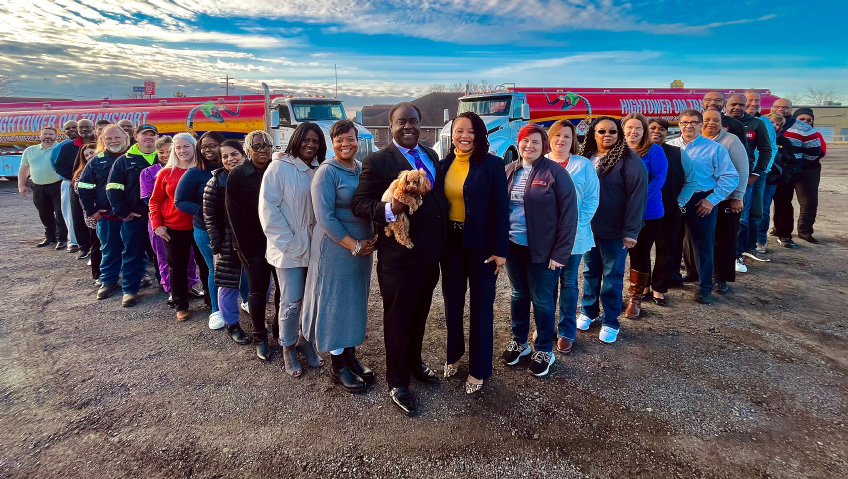
Despite his many success stories, Steve Hightower remains modest about his business achievements. Founder and CEO of Middletown, Ohio-based Hightowers Petroleum Co., Steve is a different breed of entrepreneur. Instead of keeping his years of experience to himself, he openly shares his knowledge with others, especially the next generation of aspiring businesspeople. Last year, this culminated in the publication of FUELING: From Zero to $1 Billion.
In his book, Hightower discusses the countless lessons he learned from his parents while working for their janitorial company—navigating racial barriers, financial hurdles, and underscoring the importance of keeping your word to employees, industry partners, and customers. “There are a lot of people who want to be in business but don’t really know how, and don’t think that it’s possible,” he shares. “Having been in business my entire life, I just thought that, at my age, I need to leave something behind.”
Prior to building his petroleum business from scratch, Hightower worked at his mother and father’s business, Hightower’s Janitorial Service, in the Middletown, Ohio area. Before he even entered his teens, Steve Hightower showed up at work early on as a child with his Mother and Father, cleaning offices and commercial and residential properties. By the time he was 16, he was a crew leader with adults working under him. Ambitious and with an eye on the future, the young entrepreneur grew the family janitorial business from Middletown to Dayton, Cincinnati, and then statewide. “I was that generation who took a baseline family business and developed it into something more,” he says.
From fundamentals to finance
Watching his parents closely—and accustomed to hard work as a youngster—Hightower was a fast learner. Even today, he believes you need to create a solid foundation to be successful, no matter the enterprise. “Business is basic; you have to understand finance, pay your bills, and know how to invoice,” he states. “And whatever product or service you are offering, that has to be delivered, and delivered on time. Get a product that a company has to have to execute, versus a product that people may want to have—product that is moving every day even while you sleep.” He cites the supply chains of paint (“without resin, there is no paint”), gasoline (“without crude oil, refineries would shut down”), and consumer goods (“you can’t ship or sell without packaging) as examples. Critically, Hightower says, “Trust is built, not assumed! People have to know that they can trust you, and it always helps if they like you.”
Taking on more responsibility managing others, Hightower grew the janitorial business and connected with big players. This included selling industrial materials to the Ford Motor Company in Sharonville. He took advantage of a statewide program, HB: 584, which afforded companies owned by persons of African American, Hispanic, Native American, and Asian descent the ability to bid on certain contracts in Ohio. Other opportunities presented themselves, and Hightower pursued more procurement contracts. This included a huge opportunity when Landmark Supply Co LTD, wholly owned by Steve, bid a fuel contract which energy giant BP had held for 32 years.
Hightower knew how to find a supplier. “If you have an opportunity big enough, you can find a supplier for it, as long as he knows he can be paid,” he says. His first fuel contract was for the entire State of Ohio in 1982, and to this day, Hightower credits the late Don Lykins of Lykins Oil, who quoted him as his supplier, providing product and a credit instrument that secured the sale to the state of Ohio.
The contract revealed Hightower’s confidence. “I did not know anything about petroleum. I did not come from the industry, I did not work for a petroleum company,” he says. “And at that particular time, he remembers saying to his people—even though it was only two or three people at the time—‘Whatever our part, we need to do that well.’ “Thus the beginning of learning the business.
Thanks to Lykins, Hightower learned about a credit instrument that allowed the company to gain credit by utilizing a “lockbox.” This, he says, was the key to his ability to grow in the business, because he could secure funding to his suppliers by having customers send checks to the bank’s lockbox; once the check arrived, the bank was instructed to send the money to the supplier, i.e. Lykins, initially under the name of Landmark supply Co LTD.
“The bank had no liability, because they only had instructions to transfer the dollars to my supplier,” he says. “I could not get a bank loan for petroleum. None of the local banks would trust me to be in the oil business. To them I was just a janitor… I was told by a diversity professional of a construction company in Cincinnati to stay in my lane. How I was able to get to doing hundreds of thousands of dollars in business was through the use of the lockbox.”
Hightowers Petroleum continued to grow, and the business reached $235 million after many years, before HPC got its first commercial bank loan. “No one believed that I should be in the petroleum business, but you learn how to manage with what you have. You’ve got to be creative, and you’ve got to deliver, and most importantly you have to have the courage to succeed. We were able to deliver, and that’s how I really got started.”
The evolution of energy
Following the initial contract years later with the State of Ohio, the company was called to Cleveland and won an opportunity to haul jet fuel to Government locations BP was fulfilling. “They selected us to become a ‘Contract Carrier’ for BP after they supported and help secured our PUCO (Public Utilities Commission of Ohio) status, which allowed the company to transport jet fuel to various government entities within the state for BP.” It was at that point that Steve incorporated “Hightowers Petroleum Company” in 1984 and had the credentials to officially be in the fuel industry.
Today, Hightowers Petroleum remains a leader in energy solutions. A safe, environmentally responsible wholesale fuel supplier, the company’s reputation is unparalleled, with a 99.9 percent on-time delivery rate. The company’s Focused Energy Model is unique and “designed to minimize energy spend, maximize energy efficiencies, and optimize your company’s success by having a trusted single source manage all of your energy requirements.”
Establishing its reputation as a trusted supplier of traditional fuels in the downstream such as gasoline and diesel fuels, today the company is moving upstream to include crude oil, liquefied natural gas (LNG), and supplemental products such as diesel exhaust fuel (DEF), additives, and lubricants. Hightowers Petroleum keeps investing in the future of energy. Our “HPC Mastercard® Fleet Card” is nationwide serving every state in the USA with discounts at the pump for our commercial customers, both fleet and Class A vehicles,” says Hightower. “Additionally, we follow our customers and provide alternative fuels which include renewable diesel and hydrogen for fleets produced on site; emerging technologies such as nano nuclear reactors; small-scale reactors; carbon credits; and electric vehicle (EV) charging station infrastructure,” he says.
“EV is a Johnny-come-lately,” says Hightower. It is a piece of the company’s automotive business, which includes General Motors, Volvo, Nissan, and Mack Trucks. “When your automotive customers are moving toward EV and electric, you don’t want to be the last horse and buggy on the street, so you get ahead of the game. That’s why we went toward EV.”
The company’s construction arm, Hightower EV Solutions, is growing in response. Currently, there are 15 or 16 major turnkey EV installations going on across the country, from California to New York to Miami. This work comprises installing EV charging stations, infrastructure, charging stations, and electrical upgrades. “That’s where we’ve done very well with Hightower EV Solutions, and it is growing quite rapidly,” says Hightower. The company also owns the software for many EV stations and provides 24/7 maintenance service to customers.
Navigating change
Even with the current global uncertainty surrounding petroleum because of the closures at the Strait of Hormuz, business remains solid. “The good thing about this industry is whether its crude oil, gasoline, or diesel, they need to have it,” says Hightower. “Price might be a factor, but you’ve got to pay it anyway, because you need it for your refineries. Refineries can’t shut down.” The price of freight has gone up from $2 to $12, and the product has increased from $45 to $50 dollars a barrel to $100 to $110. “Instability has its challenges, however it also has its opportunities. It’s time to lean in, not put your head down, but to ‘step up.’” Hightower is moving full force in the upstream opportunities created that were not available prior to this disruption.
While this has caused plenty of conflict and confusion in the petroleum industry, it has also created opportunities. “We look at it from an opportunity standpoint, and basically just lean into the situation and continue the route we were on, namely maintaining and managing our downstream customers on a daily basis.” With a presence in every state in the continental U.S., Hightowers Petroleum is also entering Puerto Rico and Hawaii. To achieve this in the downstream, Hightower and his team are buying product throughout the United States and managing the supply chain of carriers that carry product to almost every major city in the U.S.
“We’ve been able to do that one customer at a time,” he says. “We have hundreds of customers now, 99 percent private sector.” His philosophy is, “If you take care of your customers, your customers will take care of you. When times get hard, companies are still looking for people who will answer the phone, show up, and do what they say they’re going to do! And that’s been our success model.”
For years, Hightowers Petroleum has maintained a philosophy of going deep, not wide. The company started with fuels like gasoline and diesel long before adding EVs. Other factors behind the company’s success include MasterCard fleet cards and offering discounts to private companies with large fleets throughout the U.S. using Hightowers products and services.
Building the business on wholesale downstream fuels, Hightower says upstream, like crude oil and LNG, is totally different. A load of gasoline or diesel fuel of about 9,000 gallons going down the road is approximately $30,000 to $35,000; a load of crude oil, about one million barrels per shipment, amounts to some $85 to $100 million per shipment. “$30,000 versus $100 million? That’s a big leap for a little guy,” says Hightower, who brought in experts specializing in trading crude and upstream over the past three years. Owing to this, the company now has customers in Europe, the United Arab Emirates, and Africa.
“That’s because I continue to work in our vertical, but in a different portion within the vertical of petroleum products, and that’s where we stand today,” Hightower explains. “We are taking advantage of opportunities being posed by all of the confusion that’s going on, because we’ve got relationships with China. With our Chinese partners, we can go through the Strait of Hormuz.” And with Europe being short on crude oil, customers are looking for safe places to purchase product, and the U.S. is considered one of those safer places, as opposed to Mexico, Central and South America, or certain countries in Africa. Customers are extremely comfortable purchasing petroleum from Hightowers Petroleum.
“When you have a disruption, that, again, is opportunity. Fortunately, we worked for three years building a foundation upstream, and the environment became what it is. There is a shortage and a need, and Hightowers was well-positioned after 44 years in the petroleum industry, and able to get partners from Europe and the UAE and here in the USA. One criterion for exporting fuel or crude from the U.S. is, there needs to be a base in the U.S. Hightowers Petroleum has become that partnering business in the U.S. for about four different major corporations and has been able to execute in the market despite shortages. “The advantages we put in place allowed us to be prepared, so this was not a disaster for us. It was an opportunity, and an opportunity to succeed.”
Continuing on its path, Hightowers Petroleum recently formed a partnership with multinational giant Shell with its MasterCard fleet card. Offering some of the deepest discounts in the country, Shell took notice and partnered with Hightowers. When the fleet card was released in 1985, it was a loss leader; today, it is a very profitable part of the business.
A foundation for the future
Years after founding the business, Steve Hightower says much of his success comes down to drive, respect for customers and employees, and treating people right. “This is an industry of reputation,” he says. “It takes a lifetime to build a reputation, and it takes 15 seconds to lose it. The difference is, I grew this company from scratch without basically any money, no outside investors, and no big loans available to me. Today, I am still a 100 percent owner of a C-Corp—typically, most companies today have either sold off, sold to someone else, and are not around. Longevity comes from being honest with people.”
Hightowers Petroleum’s reputation is the result of hard work, dedication, professionalism, and on-time delivery. These attributes, and others, have seen the company recognized for its work. A couple of the most recent was the Better Business Bureau Torch Award for Southwest Ohio and the “Sustainability Award” from Honda NA. competing against all of their vendors in 2026. Although this is a validation, Hightower says the company’s work in the community is just as important. Along with being active on many boards, the company also adopts classrooms and sixth graders with a program that exposes schoolchildren to the petroleum industry within classroom education and small exercises, along with field trips to learn about the oil and gas industry.
For years, Steve Hightower has championed public speaking and still carries his love of high school debate to this day. This includes taking local kids from Middletown to the Ohio Statehouse in Columbus, Ohio for Youth and Government mock legislation. These are the real reasons he wrote FUELING. “They compete against other schools from across the country,” he says. “When people ask, ‘Why did you write a book?’ it’s because those kids are our next generation. I have to leave my knowledge for somebody, because none of us are going to be here forever.’” In Hightowers Petroleum, he is building a legacy to last.