Located on the unceded territory of the Haisla Nation, the District of Kitimat, British Columbia is a region that is rich in resources and collaboration, both of which have contributed greatly to the economic growth and prosperity enjoyed by those who call the area home.
Incorporated as an industry town in the 1950s—the first community without residents to do so in the province—Kitimat continues to leverage its resources and its relationships to push the economy forward and preserve the enviable way of life it affords—a way of life that is due in large part to industry partners.
As Mayor Philip Germuth explains, “Kitimat is a very industry-friendly community when things are done properly,” and the investments that have taken place in the community are evidence of that.
Industry first
As an industry town, Kitimat, British Columbia had an interesting start.
The community was founded when the Aluminum Company of Canada (Alcan, now Rio Tinto BC Works) identified the area for what was a massive engineering undertaking at the time. The Alcan Project ran from 1951 to 1954. Through the construction of the Kemano hydroelectric dam, a 16-kilometre-long tunnel, a deep-sea terminal, an aluminum smelter, and the surrounding community, Kitimat came to be.
Considered the most expensive private project in Canadian history at the time, this was an intentional effort for industry and community to thrive alongside one another. Alcan brought renowned city planner Clarence Stein out of retirement to execute a vision for a planned garden city that existed separately from industry. Stein looked at prevailing wind patterns to isolate the community from the impacts of industry and found a way to design a community that is well connected, aesthetically pleasing, and could support the needs of the individuals and families that keep industry functioning.
Boom and bust
At its peak in the 1970s and 1980s, Kitimat had grown to a population of 13,000 people, but not unlike the rest of the world, the global financial crisis took its toll, and the market became incredibly challenging. For instance, Methanex, which established its ammonia and methane operations in the 1980s, sadly closed in 2005, while Eurocan Pulp and Paper Co., which had operated in the community for 40 years, closed in 2010, taking with it hundreds of jobs and leaving industrial lands sitting idle.
Industry boom and bust cycles are never easy to weather, but luckily for Kitimat, the hard times were short lived thanks to new investment partners who ushered in a new wave of growth and opportunity.
“Since the final investment decision by LNG Canada in 2018, the community has seen significant population growth,” notes Walsham Tenshak, Director of Economic Development and Communications for the District of Kitimat, who referred to this growth as “astounding.”
Over the last five years, Kitimat has experienced a nearly 20 percent increase in population, going from around 8,500 in 2020 to 10,000 people today, according to BC Stats. As such, Tenshak notes, “Council has had to work with industry to look at how we can expand the services that we provide to care for more people as they come to the community, and industry partners have been excellent corporate citizens.”
Indeed, there have been several milestone moments in Kitimat’s history that have altered the trajectory of the community. Rio Tinto’s acquisition of Alcan in 2007 was one of them. The Rio Tinto Alcan acquisition breathed new life into the community, not only through a major investment to modernize the smelter, but through other investments in infrastructure that support the community.
“In 2015, they completed a multi-billion-dollar investment in a modernized smelter, which now has us producing the greenest aluminum anywhere in North America,” explains Mayor Germuth. He tells us that another key move came from LNG Canada in establishing Kitimat as a global natural gas export hub.
Having recently completed its hundredth shipment, LNG Canada is now considering proceeding with Phase Two of the project, a $33 billion CAD expansion of its export facility which will double production from 14 to 28 million tonnes of LNG (liquefied natural gas) annually.
Mayor Germuth also highlights the value and impact of the Cedar LNG project, which showcases the unique nature of partnership and collaboration between industry and the community.
Cedar LNG is valued at around $4 billion USD and is not only regarded for the magnitude of its investment but also the fact that it is the world’s first Indigenous majority-owned LNG facility, developed in partnership between the Haisla and Pembina Pipeline Corporation. Designed to operate using renewable energy from BC Hydro and to connect to the Coastal GasLink pipeline and local power grids, construction activities commenced in 2024 with completion expected in 2028, when it expects to deliver its first shipments of low-carbon LNG overseas to the Asian market.
As many communities know, investment breeds investment—and that is certainly the case in Kitimat. As Mayor Germuth notes, “The investment by Rio Tinto into modernizing the smelter plus the LNG Canada and Cedar LNG projects have given a lot of other people the courage to reinvest in their properties,” which is leading to a new wave of revitalization including new residential developments as well as retail, hospitality, and commercial investments.
Maximizing industry’s impact
The high wage opportunities in Kitimat not only afford an exceptional quality of life; they also enable a higher rate of entrepreneurship, as families have the economic freedom to pursue their interests with efforts that have the full support of the community behind them.
For those who take the chance, organizations like the Kitimat Chamber of Commerce and programs like Business Bootcamps and Entrepalooza, as well as industry programs like the LNG Business Growth Fund, are there to make the leap into business ownership a success.
In fact, industry is behind a lot of the growth and success taking place in Kitimat, with the Haisla Bridge project serving as a perfect example. Built in 1954, this critical infrastructure was in dire need of replacement. “That’s the main bridge that connects the community to the industrial area and it’s the only way to get to the industrial area,” explains Mayor Germuth. “LNG Canada was able to lobby the government to have them take care of the whole thing for us, so we were very thankful.”
Completed through a joint partnership, the Ledcor-Haisla Limited Partnership, the bridge was opened in 2023 and not only showcases the connectivity between industry and the community but also pays tribute to Haisla through traditional art, serving as a physical reminder that industry in Kitimat is strong, but community is stronger.
To be sure, companies like LNG Canada find countless ways to give back to the community in a very big way. The company committed more than one million dollars in funding to support the Kitimat General Hospital Foundation and the Kitimat General Hospital to purchase a computed tomography (CT) scanner as well as an electrocardiogram (ECG) machine, which improve patient outcomes locally and contribute to physician attraction and retention efforts.
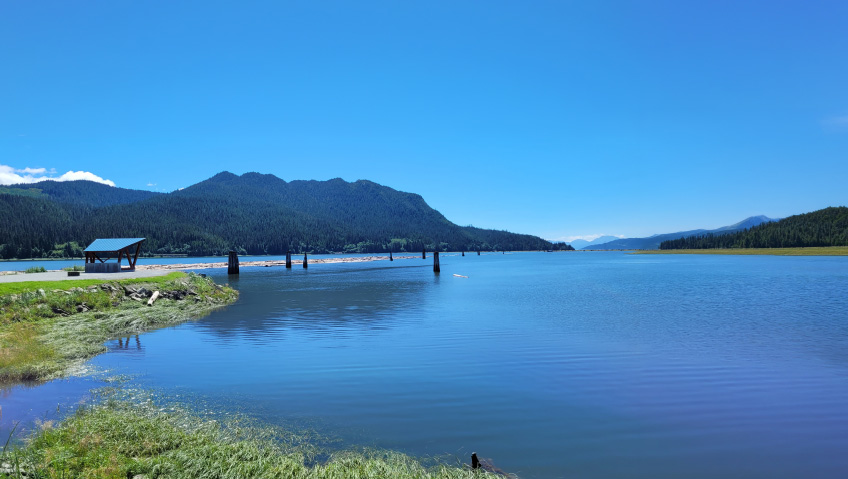
The company also supported the community’s Dementia Home Project currently underway, and the construction of a kayak launch at Minette Bay West Park that gave the community its first saltwater access point, which is attractive to residents and visitors alike. “Rio Tinto donated the land in the bay in 2014 and then LNG Canada gave us money to develop it,” explains Mayor Germuth.
Being a safe community with abundant services, recreational opportunities, and amenities, a good school system, and a strong economy make Kitimat an attractive community to call home, but also make for an attractive place to visit, which is evident in the latest tourism figures.
“Tourism in our region grew by about 35 percent last year, and we’re welcoming more visitors than ever through our doors. What’s really interesting is that many of them are just as eager to learn about Kitimat’s industry as they are to experience our natural attractions,” explains Laurel D’Andrea, Executive Director of the Kitimat Chamber of Commerce.
Supporting the movement of goods, people, and opportunities
Access, proximity, and connectivity are other key parts of the overall value proposition offered by the District of Kitimat. With water, highway, and air infrastructure, from Kitimat, you can get anywhere! “We like to say that we are the very start of the highway, so you literally start here and can go everywhere,” says Tenshak of this connectivity. “We have great road networks, the province and the district invest heavily in ensuring that people stay connected, and we have an airport that’s just 30 minutes away,” she says. “You get to have the world as your oyster.”
This is what happens when a community is intentionally designed and thoughtfully developed: it is rewarded with continued growth and development and an unmatched quality of life, something that would not be possible without partnership.
“There’s lots of opportunity here, and again, you have a community that wants to work with industry,” Mayor Germuth says of a commitment that has long served the community and will continue to do so for decades to come.
The goal at its core, he notes, is to make Kitimat “a balanced, desirable community that people want to call home and where they can pursue their opportunities,” a place where everyone is welcome and where individuals and businesses thrive.