
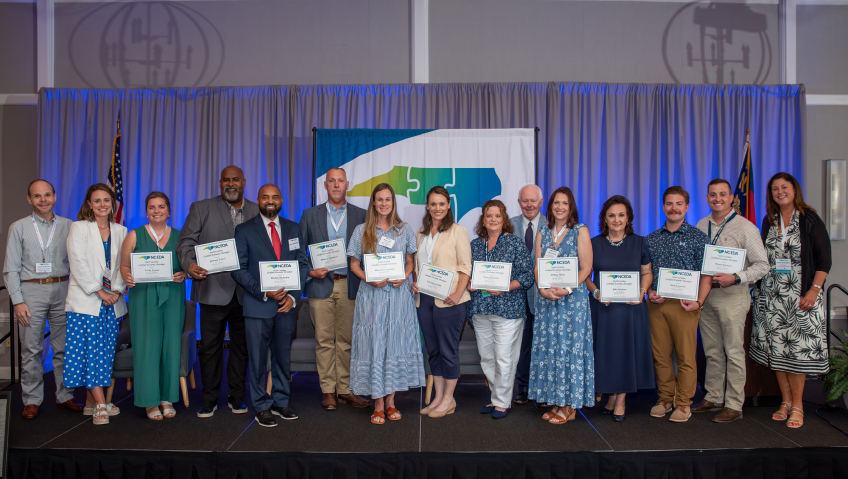
For six decades, the North Carolina Economic Development Association (NCEDA) has helped strengthen the professional network, policy environment, and partnerships that support North Carolina’s economic competitiveness. This year, the association marks its 60th anniversary, and with membership approaching 1,000 professionals across the state’s 100 counties, it shows no sign of slowing down.
NCEDA’s roots go back to a core mission of supporting the professionals working to bring jobs and investment to North Carolina. What began as an industrial development group has today grown into a full-fledged professional association supporting economic developers across every corner of the state.
“We’re actually 60 years old this year,” President, André Lennon says. “We celebrated in spring 2026. The association started as an industrial development group with the purpose of supporting economic developers in the state of North Carolina in recruiting industry to this state, helping bring jobs to the state, and supporting our citizens.”
That founding purpose has scaled dramatically. Today NCEDA counts nearly 1,000 members, a mix of economic development practitioners and ally members, professionals who support practitioners through site readiness work and other services that fuel business growth.
The organization itself runs lean. As a not-for-profit membership association, NCEDA is governed by a volunteer board and works alongside the L2 team. “NCEDA is a not-for-profit membership association of economic developers from across the state of North Carolina,” Vice President, Clark Duncan, explains.
The board draws its strength from geographic and professional diversity, helping NCEDA understand and advocate for the differing needs of urban, suburban, and rural communities across the state.
Ask NCEDA’s leadership what’s fueling North Carolina’s economic momentum, and several sectors consistently rise to the top: aviation and aerospace, automotive manufacturing, biotechnology, technology, and data all remain strong performers.
“What’s exciting is that they’re pretty consistent across the state of North Carolina,” Duncan tells us. “We are a state that continues to see a lot of growth and investment in aviation and aerospace, and automotive manufacturing. Biotechnology remains dominant, as does technology and data.” He adds one more sector to the list—food and beverage—which he describes as a consistently strong performer for the state.
For a state routinely ranked among the best places in the country to do business, the reasons go beyond any single factor. Geography plays a foundational role, according to Lennon, who points to the state’s position in the Southeast and on the East Coast as an advantage that simply can’t be replicated.
“North Carolina has been very competitive over the past decade, and our geography is one of our competitive advantages that you can’t make up,” he says. “We have some quality of life advantages that assist us, but also the business climate is one of our strong competitive advantages as well. There’s a tax structure that’s set up that supports and incentivizes business investment.”
Duncan builds on this point, emphasizing the role NCEDA plays in sustaining a favorable long-term cost of doing business through relationships with legislative leaders. “Working with our legislative leaders, reminding them of the importance of having a long-term cost of doing business that’s favorable for companies,” is central to the association’s work, he says.
He also points to infrastructure investment, adding that the state’s interstate and highway network is a major asset, giving companies an efficient way to move products to customers. That, paired with a tax structure designed to let companies reinvest in themselves and in North Carolina over time, rounds out the state’s competitive edge.
The team also highlights a critical piece of the competitiveness puzzle: state investment in project-ready sites. Preparing properties in advance through due diligence and infrastructure investment can reduce risk and shorten speed-to-market for companies evaluating North Carolina. “There’s a lot of investment coming from the state to intentionally help and spur economic development all across North Carolina,” Duncan says, “and that makes for a big competitive advantage, along with our workforce solutions.”
While the North Carolina Department of Commerce and local governments administer most formal incentives and grants, NCEDA’s role is less about the dollars and more about the connective tissue between them. Lennon describes the association as a bridge linking the state’s many resources into a coherent, collaborative whole.
“We want our most rural counties to be as successful as our most urban,” says Lennon. “An association such as ours that represents the entirety of the state really thinks about how we share resources, how we advocate across all of our diverse members, so that we can come together to support project wins in all parts of the state.”
NCEDA connects its members to partner organizations such as the North Carolina Railroad and the Golden LEAF Foundation, which support site readiness and infrastructure funding. “Our association, being a member trade association, is the connector,” Lennon says. “We’re helping provide professional development opportunities on how to apply for those grants where they’re best administered.”
Workforce development runs through nearly every conversation about North Carolina’s competitiveness. NCEDA advocates for workforce policies and investments that respond to employers’ needs while also helping develop the next generation of economic development professionals.
“Over the last 15 to 20 years, North Carolina has been a real leader in investing in education and workforce development, which is necessary for effective economic growth in any state,” Lennon says. Through its foundation, NCEDA also invests in the future of the economic development profession through mentorship, internship, and other programs designed to bring new professionals into the field.
The connection between workforce policy and successful business recruitment can be seen in Rockingham County’s recent recruitment of TSEA Energia, a Brazilian manufacturer establishing its first U.S. manufacturing facility in the county. TSEA places a strong emphasis on apprenticeships and developing its workforce through hands-on learning—exactly the type of employer need that has shaped NCEDA’s advocacy for greater state investment in apprenticeships, community college programs, and other work-based learning opportunities.
“When we advocate for workforce funding, it’s because we hear directly from companies about what they need to be successful,” says Leigh Cockram, Director of Economic Development and Tourism for Rockingham County. “TSEA is a great example. Apprenticeships are an important part of their workforce model, and our community college and workforce partners are working with the company to help build that pipeline here. At the same time, the state has increasingly recognized the need to invest in apprenticeships and other work-based learning opportunities. That alignment between what employers need and where we invest our workforce resources is critical if North Carolina wants to continue winning projects and, more importantly, help those companies succeed after they get here.”
NCEDA’s flagship talent initiative, Career Trek, through its partnership with the NCEDA Foundation, actively recruits promising college graduates into economic development careers with the goal of sending them back to their home communities as future leaders. “We’re actively recruiting very promising college graduates from across the state into economic development professions so that they can go back into their hometown communities and take a leadership role in unifying businesses and educational and academic allies with our elected leadership to strengthen the economies of all 100 counties in the state,” Lennon says.
That long-term investment extends to mentorship within the profession itself, pairing younger economic developers with senior colleagues to build institutional knowledge and a shared sense of purpose.
Indeed, NCEDA’s programming reflects an intentional effort to support members at every career stage. Alongside Career Trek, the association runs an Emerging Executives group for early-career professionals, offering programming tailored to those just beginning in the field. A mentorship initiative pairs senior members with early-career professionals to encourage knowledge sharing across generations. And the Practitioners Workshop, now in its third year, rounds out the offering for members further along in their careers.
“We have a representative each year on our board who provides insight into their perspective and the key ideas they want to hear at our conferences and other meeting content throughout the year,” Lennon says of the Emerging Executives group.
Duncan echoes the sentiment, framing NCEDA as a professional home regardless of where a member is in their career or where they’re based in the state. “This organization is the place where, no matter where you are in your career, we’re here for each other; it doesn’t matter where you are in the state, your age, or your demographic,” Duncan says.
One of NCEDA’s most consistent contributions is its legislative advocacy, which channels feedback from economic developers across the state’s 100 counties to lawmakers in Raleigh. That work depends on both strong relationships and NCEDA’s credibility as a statewide voice for the profession. “We have a great relationship with lobbyists and advocates in Raleigh, but we also take the time to understand and know our legislators and make sure they’re aware of what we need,” Cockram says.
NCEDA has consistently advocated for greater and more predictable state investment in site readiness, including due diligence and infrastructure needed to make properties more competitive for projects. “It’s really important that we also maintain a level of prestige and respect from our legislators, so they know that when we’re coming to them, it’s for something that’s truly needed statewide,” Cockram says, “not specific or self-serving for any one sector of our membership.”
Looking ahead, the competitiveness challenge is broader than any single program: North Carolina must continue aligning policy and investment around the full economic development ecosystem—project-ready sites, infrastructure, utilities and energy, workforce and education, housing, transportation, speed-to-market, and a predictable business climate. One area of ongoing advocacy is expanding funding for project-ready sites, where speed to market has become a critical competitive factor.
“We’ve seen additional funding for site readiness, whether that’s due diligence studies for industrial sites or other infrastructure improvements to have these sites ready for projects when they’re relocating to our state,” Lennon shares.
Ultimately, he credits the association’s success to something less tangible than funding or sector strength, and that is collaboration. “Organizations like NCEDA really set the state of North Carolina apart in the very competitive economic development landscape in the United States,” he says. “You have to have great land, products, and sites. You have to have a highly skilled and adaptable workforce. But really, the magic is in collaboration and how you pull together teams across universities, industry, and government to support economic growth. That remains a key priority for NCEDA.”
After 60 years, NCEDA’s next challenge is not simply to celebrate North Carolina’s success, but to help sustain it. With nearly 1,000 members and a statewide network of practitioners and partners, the association is positioned to help ensure that the policies, investments, and collaboration that made North Carolina competitive continue evolving for the next generation of projects and communities.