In a time of needed economic growth to create sustainable futures for citizens, Boone County stands out as the prime location for an all-encompassing work, play, live environment. Boone County Economic Development Corporation (EDC) has a shared vision for a thriving, connected, and prosperous future for all municipalities and Boone County itself. Growing from a primarily agricultural hub founded on April 1, 1830, the county’s fastest-evolving sectors are life sciences, technology, and advanced manufacturing.
For business leaders, workforce partners, site selectors, entrepreneurs, and even prospective residents on the lookout for an economically progressive county, Boone County’s economic vitality has established they are here for the long haul. Recognized as Indiana’s County of the Year in 2023, its location on Interstate 65 places Boone County within 30 minutes of Indianapolis International Airport and within a day’s drive of around half of the United States population.
Boone County has strong corridor access to Interstates I-65 and I-74 as well as the ability to connect rail systems from business parks. This positioning makes transportation to and from the county just one of its many pluses for existing and prospective business partners. With significant investment in internal roads and utilities, the county’s infrastructure is becoming more modern, efficient, and able to handle the growth. Such investments further secure prospects for its well-established advanced manufacturing industry. Internationally recognized names in life sciences, such as Eli Lilly and Company, have found a home in Boone County. Eli Lilly’s investment totals nearly 18 billion dollars, one of the largest capital investments in Indiana’s history.
The area is also known for large distribution facilities, including those of international equipment giant Caterpillar and NewCold, a well-known cold storage provider. Having firmly established their presence through initial investments, both companies have now chosen to expand their footprint. In the process, Caterpillar recently established a new advanced manufacturing facility in Lebanon. Business retention and expansion is an area Boone EDC understands is of great importance when it comes to creating long lasting growth for the county.
Strategically located at the center of the state, more than half of this 108,500-hectare county remains agricultural land. Recent decades have brought strong growth and a long-term vision to create prosperity for all its communities, and as a result, the population of Boone County grew by over 70 percent to around 80,000 residents over the past 27 years, making it the second-fastest-growing county in the state of Indiana. Awash with young professionals, more than half of their over-25s hold bachelor’s degrees, rating their education status amongst Indiana’s top two counties.
One of the county’s most successful economic drivers at present is the Limitless Exploration Advanced Pace District, commonly referred to as LEAP. This powerful development is considered the United States’ largest innovation district to date. “LEAP is also a reflection of the strong partnerships that we have with our municipal partners, with the city of Lebanon and Boone County government, as well as the Indiana Economic Development Corporation (IEDC),” says Andrea Kern, CEO of Boone EDC.
LEAP investments have brought a significant boost to Boone County’s local infrastructure, in addition to each organization’s own campus. This includes the installation of a new interstate 65 interchange, internal roads, and additions to walking and biking trails. Moreover, Meta is supplying most of the water infrastructure, complete with a closed-loop water consumption system to serve its data center demands, and has taken ownership of the costs of the needed growth for electricity infrastructure. “[Electricity infrastructure] is not a cost that’s being taken on by ratepayers within the city of Lebanon or Boone County,” Kern tells us. “META has demonstrated that they are committed to being a great community partner by investing in a number of nonprofits.”
These are all large commitments, and so is Meta’s efforts to fund a workforce training program that will partner with Associated Builders & Contractors (ABC). This training promises to provide candidates with national certification and guaranteed work. META’s initial investment of 115 million dollars will power the program, called America’s Workforce Academy (AWA).
META also extended a $100,000 subsidy to Boone Power to support those unable to pay their electricity bills, while another $100,000 grant went to the Boone County Career Collaborative, allowing the county to further support its three local school districts, Lebanon, Zionsville, and Western Boone Schools, in navigating and implementing recently amended statewide graduation requirements—changes already impacting current freshmen and sophomores.
New diploma guidelines require between 75 and 650 hours of work-based learning for students. “What we’re really trying to do is help support the schools however we can and make sure that these are quality workforce learning hours. Connecting them with our businesses even comes into play with our business retention and expansion plans,” says Denise Niblick, Director of Business Engagement and Partnerships.
Niblick further highlights that making these programs optimally valuable for end users and learners is a priority. To this end, the Boone County Career Collaborative aims to provide extensive support to learners, counselors, businesses, and other stakeholders through coordinating candidates with internship opportunities and other workforce training. Its contribution also extends to resources such as funding curriculum development, work-based learning facilitation, and materials such as personal protective equipment or technology needed for students’ workforce learning experiences.
“I think you would be hard-pressed to find a county that is as willing and able and has a desire to support youth in their community as Boone County,” she continues, noting how beautiful she finds it that business owners have been proactive in reaching out to the EDC, offering their support of their own volition. It is also exciting to see a growing number of parents agreeing that many trade opportunities offer undeniably good remuneration packages—even compared with professions requiring formal tertiary education—all while accruing zero debt. It is now accepted that the sky is the limit for young people who first train in trades and choose to further their education and careers at a later stage.
Good education is, of course, just one aspect that families looking to move here consider. Making her way from downtown Lexington, Kentucky to Lebanon, Indiana in Boone County, Niblick, for one, could not be happier. As a married young professional with two children, there is a lot keeping her here, from the extensive infrastructure investments the county has made since COVID to glorious natural beauty, trails, and parks. One of Boone County’s most recent redevelopments is Carpenter Nature Preserve, a 215-acre former 18-hole golf course turned conservation destination located in Zionsville. There is also the 110-acre former Lebanon city landfill that was redeveloped into Stone Eater Bike Park, complete with five miles of all-weather and mountain biking trails for all levels of riders. With both Chicago and Indianapolis just a stone’s throw away, locals even have access to every possible big-box store and other modern resources virtually on their doorsteps.
Owning a home here also remains affordable, despite relative scarcity. For this reason, affordable housing is one of the EDC’s priorities. The median annual wage is $56,000; the standard household income is around $104,000.
More rural options for those seeking short commutes but the benefits of a small-town feeling are coming to Thorntown, and Jamestown has an estimated 300 new homes available soon. “This is not just happening in our large communities; we are trying to work with those municipalities to make sure that they are positively impacted by the growth as well,” says Kern.
Public transportation is another priority, and getting around is made easier with the Big Four Rail Trail running through the LEAP district, connecting people from Thorntown to Zionsville and with stops in Whitestown and Lebanon.
Boone County also has connections to IndyCar racing with its Rahal Letterman Lanigan Racing team’s headquarters in Zionsville, which saw significant investments in 2022. Another well-known sports facility, alongside the Farmers Bank Fieldhouse, is a national attraction and home to the Little League Central Region Complex in Whitestown, where visitors flock from across the Midwest to attend sports events. Of course, all event visitors bring their spending power to the area’s restaurants, hotels, and other guest establishments, dollars that have a far-reaching ripple effect throughout the county.
True to its mandate, Boone EDC continues to focus on growing and maintaining the county’s economic landscape. As part of this mission, Niblick has completed three business retention and expansion visits since starting in March. “Boone EDC has decided to really focus on and foster this. Being able to retain and help businesses with a proven track record that are already in our community, who have invested in their infrastructure here, is a huge win when you’re talking about economic development,” she says. Ensuring that such businesses have everything they need to thrive and feel supported is, therefore, at the core of much of the EDC’s work.
Whether that means helping businesses negotiate their utility costs or supporting workforce transportation issues with the help of the Central Indiana Regional Transportation System, the EDC team leverages every partnership it has to fulfill its role. In the process, the EDC considers its partnerships with key contributors such as the various Boone County and Zionsville Chambers, Community Foundation of Boone County, and others as crucial to its long-term viability. “The leadership in Boone County is in alignment with the goals that we have for the future that we see here. And that means that we’re all supportive of one another,” Kern adds.
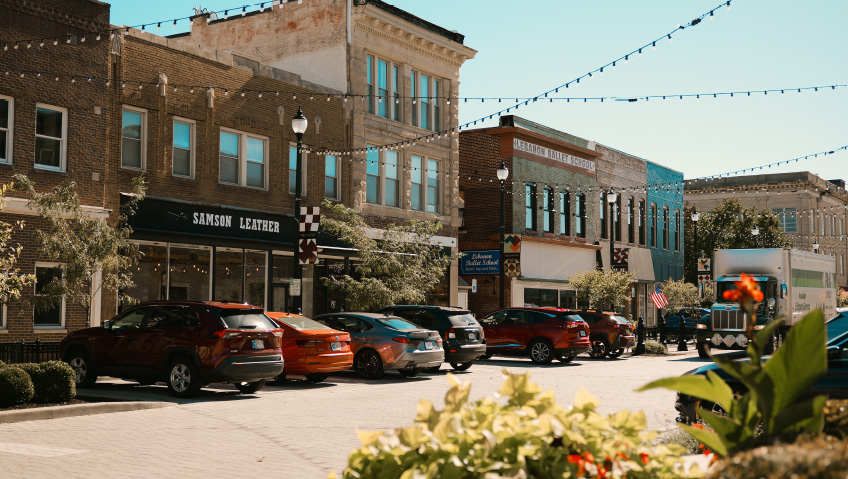
The EDC also collaborates with Main Street organizations like the Heart of Lebanon, Jamestown Partnership, and Main Street Zionsville to build and maintain healthy small businesses that uphold lively downtown areas. Bustling with markets, public events, and other fun activities, the county is described by Niblick as a place that sticks to you, but where one is never stuck—a county full of lively activity, promise, and outstanding service provision.
And while residents have had to be patient with a high volume of construction, the sacrifice is paying off as the county grows its assets and infrastructure in ways that provide an ever-improving standard of living for all. Additionally, these expansion works have fueled the local economy and added increased demand for dining, housing, and everyday goods.
With its LEAP District still under construction and bursting at the seams with recognized names in pharma, technology, and other key sectors, this phenomenal new local resource holds tremendous promise for Boone County. While forecasts suggest it will take around three decades to develop this property to its full capacity, Kern estimates that the first real returns will provide benefits over the next five years.
Taking the county forward, the EDC is clear that this is no one-man show. “Economic development really is a team sport in Boone County. The success that we’ve seen is really driven by those strong relationships that we have with a number of organizations, such as the Boone County Chamber of Commerce and the Community Foundation of Boone County,” Kern observes. As a result, through full life-cycle support and all the networking needed to keep them running at full speed, businesses continue to boom in Boone County.